
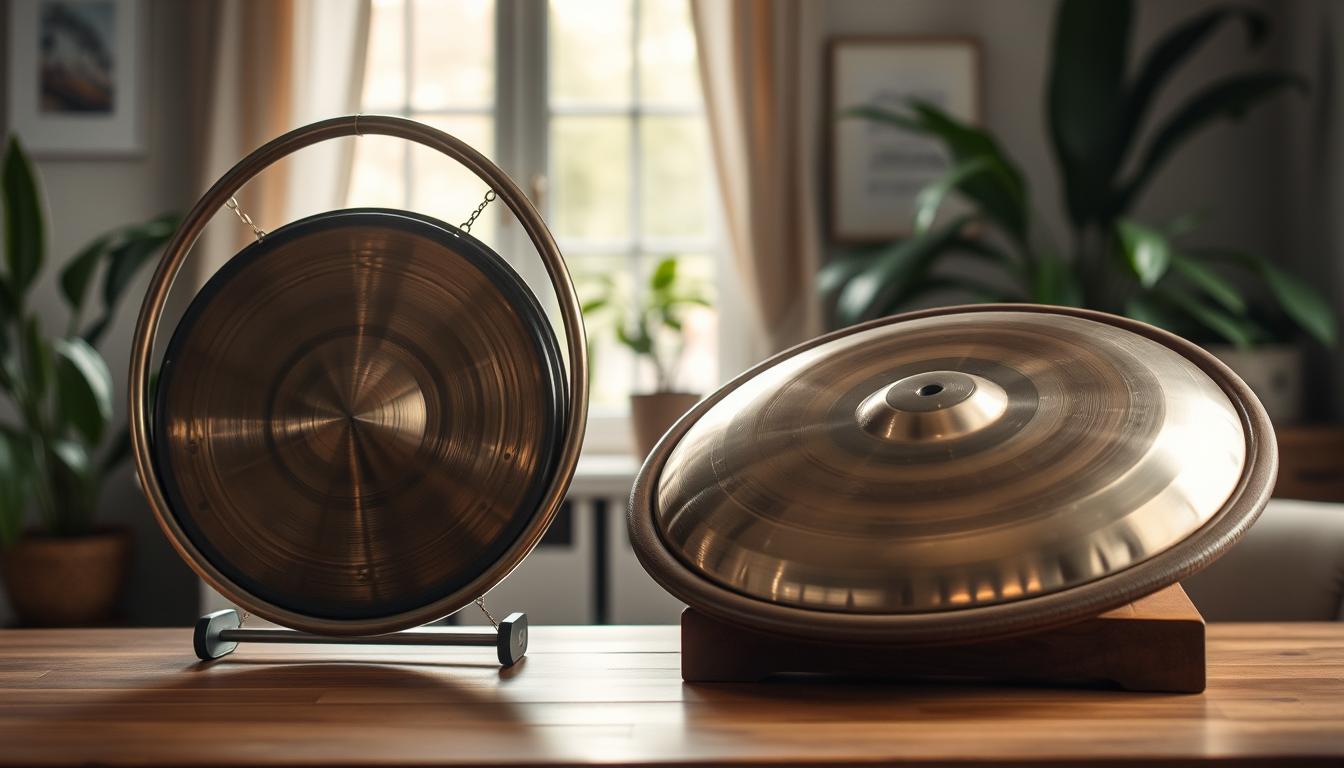

Goal: clarify what distinguishes these two instruments when buying one, trying one, or using the correct name.
Context: the playing motions are similar—both are played with the hands—but their definitions, histories, and sometimes their designs differ.
By the end of this article, you will be able to recognize visible differences, understand the legal context, compare materials, sounds, and prices, and avoid naming mistakes.
We will cover history, the legal framework, design, materials, timbre, budget, and alternative names. To learn more, see this comparison: complete guide.
Practical aim: give you concrete criteria—shape, notes, sustain, finish, maker reputation, and availability—to help you choose an instrument suited to your musical practice.
Understanding the confusion between Hang and handpan
The original model and the instruments it inspired are easily confused because they look and sound alike. Both names refer to round, tuned metal instruments designed to be played with the hands. They share the same basic principle: melodic steel percussion with notes arranged across the shell.
Why are they so easy to confuse?
At a glance, their overall shapes and playing positions are similar. To the ear, their timbres and sustain suggest the same family of sounds. As a result, many people talk about them as though they were the same instrument without distinguishing their origins.
A common naming mistake
“Hang drum” is often used as a generic name in classified ads and on social media. It attracts attention, but Hang remains associated with PANArt’s original model. To avoid ambiguity, use “handpan” when referring to the instrument family.
- Secondhand listing: “Hang” used for a generic instrument.
- Seller: the term used for marketing to attract searches.
- Conversation among musicians: a verbal habit that makes discussion easier.
Simple rule: say Hang only for the PANArt model; say handpan for the family of instruments it inspired.
Hang vs. handpan: What are the practical differences?
Since its creation in 2000, the Swiss instrument has served as the reference point for every comparison. It was designed by Felix Rohner and Sabina Schärer at PANArt Hangbau AG.
A specific model made by PANArt
Definition: it is a historic model developed and named by the workshop that created it.
Its creators, Rohner and Schärer—often named in full as Felix Rohner and Sabina Schärer—established a distinctive identity for the instrument.
A broad category: handpans
The generic term covers instruments inspired by the original concept. Makers produce many variations in shape, scale, and material.
- Listing: the name alone rarely guarantees an instrument’s origin.
- Buyer: check the maker, provenance, and tuning documentation.
- Quality: design affects playing comfort and sound.
What the community thinks
For some musicians, these are effectively the same instrument: the playing technique and musical function are similar. Others consider them two distinct instruments because of their legal status and technical design.
“The same” to play, “different” in status and design.
| Criterion | PANArt model | Generic instruments |
|---|---|---|
| Origin | Switzerland, 2000 (Rohner and Schärer) | Various workshops |
| Name | Protected name, specific model | Generic term adopted by makers |
| Variations | Specific design, limited production | Wide range of shapes and materials |
| Buyer | Proof of origin recommended | Check the maker and tuning |
A simple framework: similar playing motions, but different legal status and production choices. Keep this in mind when researching handpans and historic instruments.
Origins and history: from 2000 to today
In 2000, a new instrument appeared and quickly drew worldwide attention. Its distinctive sound and design appealed to musicians and generated considerable interest in a short time.
Origins and limited production
Production remained low: about 400 units a year. That scarcity increased its perceived value.
The consequences were waiting lists, an active secondhand market, and rising prices. The gap between supply and demand encouraged makers to develop instruments inspired by the original model.
How buyers originally obtained one
Historically, buying one required a letter explaining your interest and a trip to Switzerland. These requirements created a distinctive culture around the instrument.
For a buyer in France, the process was often more demanding than purchasing from a European maker. Many therefore looked for local alternatives.
Scarcity, controlled access, and prestige shaped the market and opened the way for new makers.
In short, rapid success, limited production, and the conditions for obtaining one encouraged makers to offer other options. This history sets the stage for the legal issues discussed next.
Law and intellectual property: the difference that changes everything
The legal dispute over the name reshaped the market and the visible forms of the instruments. In 2008, PANArt’s international registration of the term pushed the industry to adopt a generic word for other models.
Since 2020, cease-and-desist letters and lawsuits have led to the closure of businesses and workshops, especially in German-speaking countries. The situation prompted a collective response.
Organization, funding, and ruling
Handpan Community United (HCU) was founded in September 2020 to defend people working in the market. Crowdfunding raised more than €200,000 to cover legal costs.
A key development came in July 2024, when the court in Bern recognized the historic model as a copyright-protected “sound sculpture”. Such a ruling is rare for a musical instrument.
Practical consequences for buyers
- Newer makers often alter the silhouette, dome, and playing areas to avoid too close a resemblance.
- Beyond their sound, the distinction between the two instruments has become a legal one: the name and shape matter.
“The legal decision turned a question of terminology into a design criterion.”
Visible physical differences between Hang and handpan
A quick look reveals visual clues that distinguish historic instruments from newer creations.
Silhouette and profiles
The original model’s “lens” shape remains a major visual clue: a domed shell, curved profile, and smooth transitions.
Contemporary handpans sometimes have a flatter or noticeably rounder profile. These variations change the visible surface and overall appearance.
Ding, tonefields, and gu
Inspect the central dome (ding), the note fields (tonefields), and the opening underneath (gu). Their depth, diameter, and markings vary by maker.
Some models have strongly defined tonefields; others have shallower indentations that create a more continuous playing surface.
Comfort and ergonomics
The curvature and spacing of the notes affect hand fatigue. A broad surface with shallow indentations makes sliding movements easier.
Conversely, deep fields focus the fingers’ strike but can become uncomfortable during long sessions.
Visual checklist
- Note-field consistency: symmetry and depth.
- Finish: clean or polished edges, with no burrs.
- Ding and gu alignment: centering and consistency.
- Overall appearance: an even silhouette or abrupt transitions.
Why do these differences appear? Legal pressure and the desire to stand apart encourage makers to develop their own visual identities.
Practical tip: use appearance as an initial guide, then test the sound and tuning before deciding to buy.
Materials, production, and durability: Pang, nitrided steel, stainless steel, Ember Steel
Materials affect tonal character, resilience, and how well an instrument holds its tuning over time.
Pang: a distinctive steel
Pang remains associated with the original workshop. This metal contributes to the identity of the original model, though it is not its only defining feature.
Steels commonly used by makers
Other workshops use nitrided steel, stainless steel, or alloys such as Ember Steel. Nitrided steel helps maintain tuning stability.
Time, complexity, and note control
Hand production involves lengthy stages: hammering, heat treatment, and fine tuning. The complexity of the work affects the consistency of the notes.
Durability and care
Durability varies by metal: stainless steel resists corrosion better, while some alloys withstand impacts better. Heat, humidity, and impacts can put the instrument out of tune.
Quality indicators: consistent note fields, no unwanted sounds, and even dynamics. When choosing one in France, match the material to how you will use it (outdoors, in transit, or in a particular climate) and check what support the maker provides.
| Criterion | Pang / historic model | Common steels |
|---|---|---|
| Tuning stability | Good, depending on treatment | Nitrided steel better; stainless steel varies |
| Resistance | Vulnerable to impacts | Stainless steel > Ember Steel > nitrided steel |
| Care | Wipe down and store in a dry place | Stainless steel requires less care |
Comparison guide for a closer look at materials and buying decisions.
Sound and resonance: how to choose by ear
Listening remains the best test: pay attention to how long the notes last, their tonal character, and their harmonics.
Sustain and harmonic richness
Listen to the sustain: how long does a note last after you strike it? Notice whether the initial sound is clear or indistinct.
Assess the balance of the harmonics. A good instrument offers controlled harmonic richness without buzzing.
Tip: a “buzz” often indicates a tuning problem or mechanical interference.
Number of notes and scales
Common models have 7 to 10 notes, sometimes more. More notes expand your options for improvisation.
Your chosen scale shapes the mood. Some scales make spontaneous playing easier; others offer more unusual tonal colors.
Expressive or meditative playing
For meditative music, look for long sustain and an enveloping resonance.
For expressive playing, seek responsiveness, dynamic range, and a clear attack.
- Simple test: play the same sequence of notes, compare how well the sound carries, and check whether the note fields have an even volume.
- Check how well the resonance holds after several successive strikes.
- Ask local musicians what they think of the notes’ stability.
Price, budget, and availability in France: what you are really paying for
An instrument’s price often reflects its history, rarity, and the care taken with its tuning.
Why a “genuine” historic model remains rare: limited production (about 400 units a year) and restricted access kept supply low. The result was strong demand in both the new and secondhand markets.
Typical price ranges
Broad categories for contemporary instruments in France:
- Entry level: accessible prices, simple finish, variable tuning quality.
- Midrange: better tuning stability, careful finish, moderate price.
- High end: strict quality control, superior materials, maker support, high price.
What affects the price
The main factors are production time, tuning complexity, material choice, the maker’s reputation, and after-sales service.
| Factor | Effect on price | Note |
|---|---|---|
| Tuning | High | Stability and accuracy |
| Materials | Moderate | Durability and tonal character |
| Reputation | High | Quality assurance and resale value |
A realistic budget: allow for a case, secure transport, and possible retuning. These can add several hundred euros to the purchase price.
In France, consider buying from a reliable maker or dealer. Check proof of origin, ask to hear the instrument, and verify its serial number if it has one.
Practical tip: decide first how you will use it (for leisure, performance, or sound therapy). Then choose a suitable price range and check quality before paying.
To compare your options and avoid price-related pitfalls, see this useful buying guide: options and pitfalls to avoid.
Terms and names: pantam, Spacedrum, Yataopan, hangpan
Trade names often have more marketing value than technical meaning. Distinguish brand names from category names so you do not mistake an instrument’s origin.
Examples: Spacedrum is a Metal Sounds brand; Yataopan belongs to Yatao. These names distinguish product ranges without changing the type of instrument.
Product names and marketing claims
Makers use names to establish a distinctive sound identity. This can influence a purchase, especially when a listing describes a unique scale.
Pantam: origin and influences
Pantam was coined in 2004 by Ziv Yehezkel. The word combines “Pan” (steelpan) and “Tam” (ghatam). It reflects the varied influences behind some models.
Common sources of confusion
“Handpan tongue” often appears in searches. Be careful: the tongue drum belongs to a separate family based on cut metal tongues. It is not a reliable synonym for these instruments.
The blended word “hangpan” also appears occasionally. In the current legal context, it is becoming less useful. Prefer “Hang” for PANArt and “handpan” for the category, then specify the brand. For more detail, see this comparison with the Spacedrum.
Conclusion
Conclusion: the distinction is straightforward. Hang refers to the protected PANArt model; handpan covers other creations, whose shapes and makers vary.
Practical criteria: prioritize playing comfort, surface shape and hand ergonomics, note stability, and suitability for your music, whether meditative or expressive.
Before buying, listen to several instruments, compare note consistency, try playing them with your hands, and research the maker. For more detail, see this comparison guide.
Simple rule: call an instrument a “handpan” if it is not a PANArt Hang. Whatever you choose, what matters most is finding a reliable, inspiring instrument that suits your budget.