
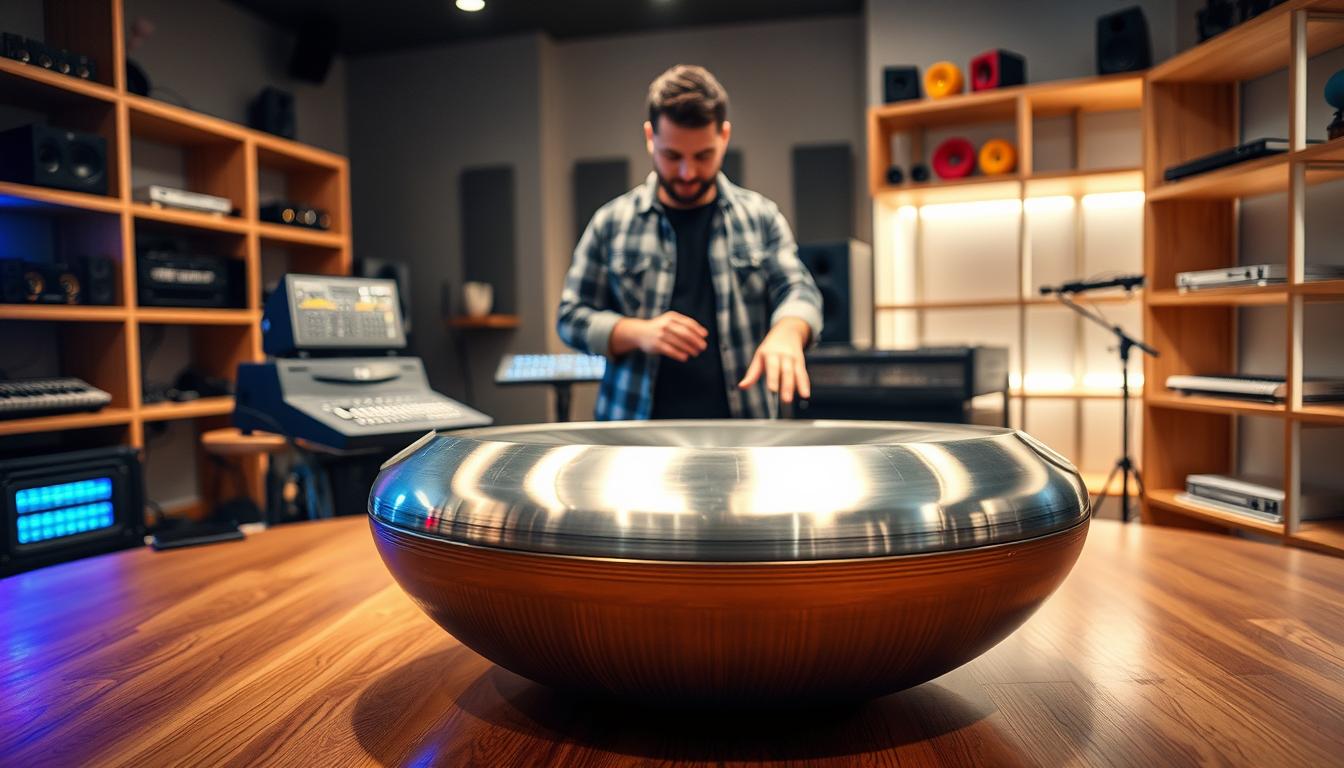

Why is this instrument attracting so much attention today? The electronic version combines sonic exploration with technical constraints. Musicians want more scales and textures. They also have questions about price, battery life and durability.
This article aims to clarify what the device actually offers. We explain who it is for. Our review covers features, sound quality, studio connections, portability, price and after-sales support.
Comparing it with an acoustic model remains essential. The shape is the same, but the experience is different. Define your expectations before buying.
Its main advantage is one instrument that can cover several scales and sounds, although there are trade-offs. We look at Neotone, Lumen and one concrete example, the Roland MN-10.
What is an electronic handpan, and how does it work?
Instead of a vibrating body, the digital version uses sensors and sound libraries to produce each note.
Definition: it retains the playing layout and note arrangement of an acoustic model, but its sound comes from a sound engine or samples.
Sensors, digital technology and the absence of a resonant body
Striking an active area triggers a sensor. The sensor sends a signal to a module, which plays a sample or synthesizes the note.
Without a resonant body, the feel changes: there are fewer physical vibrations, but presets and sound libraries provide more sonic possibilities.
Power: battery, USB or mains, depending on the model
Models can run on a built-in battery, USB power or mains power. The choice affects mobility, operating time and outdoor use.
- Battery: portable playing for several hours, but recharging is necessary.
- USB: convenient with a computer and sometimes suitable for continuous power.
- Mains: reliable studio power without battery-life constraints.
| Power source | Advantage | Disadvantage |
|---|---|---|
| Battery | Portability, cordless playing | Limited operating time, recharging required |
| USB | Integration with a PC or tablet, easy charging | Sometimes limited power, dependence on a host device |
| Mains | Stable studio power, no battery-related interruptions | Less portable, requires an outlet |
This technical foundation enables studio connections, scale changes and settings adjusted through apps. For a compact, portable example, see the Roland MN-10.
MIDI and electronic handpans: what an e-handpan can do
The ability to change pitch and scale on the fly transforms the way you play. You can switch from a D Kurd scale to a Low Pygmy scale without changing instruments. This makes exploration easier and saves time.
Sound flexibility: presets offer a traditional sound as well as tongue drum, bell and pad textures. Sound packs let you try different instruments and expand your creative options.
There are several ways to listen. You can play through headphones for private practice. A built-in speaker, such as the Roland MN-10’s 4.5 W system, is enough for small sessions. You can also connect the instrument to an external speaker for a wider audience.
Dedicated presets create settings for meditation, yoga or relaxation using pads and water or wind sounds. This instrument suits beginners because it is approachable and advanced musicians because it is flexible.
One practical limitation: some models restrict the number of active notes in a session until you change the settings. Check this against your needs.
Sound quality review: acoustic handpan fidelity and playing feel
Assessing sound fidelity requires listening to every note in several settings. Start by checking the timbre, dynamics, sustain and consistency between notes.
What to listen for:
- the timbre and texture of the notes;
- the attack and striking noise;
- note sustain and the way resonances blend;
- sound through headphones and speakers.
On some recent models, particularly Neotone, the sounds are considered highly realistic. Sampling and profiling provide excellent consistency in studio sound quality.
Nevertheless, experts often hear a difference: a slight digital edge, less organic resonance and less natural variation between notes.
The playing feel also differs. A traditional handpan responds with physical vibrations and tactile interaction. Here, feedback depends mainly on the feel of the pads and the sound you hear.
Practical advice: choose according to how you will use it. For an immersive acoustic experience, favour a traditional instrument. For studio versatility and consistency, a digital model has clear advantages.
To learn more about profiling and synthesis techniques, consult the Pianoteq manual.
Connections and studio integration: MIDI, USB-C, Bluetooth and computers
The available connections often determine how useful an instrument is in the studio. For modern music, a stable, straightforward workflow matters more than the number of presets.
MIDI-compatible USB-C
A direct connection to a computer via USB-C lets you control software and virtual instruments. It is useful for clean recording, triggering samples and automating effects without an additional interface.
Bluetooth for playback
Bluetooth is mainly used to play a backing track from a smartphone. It provides an all-in-one solution for rehearsals without a complicated setup, but check the latency for your intended use.
Audio outputs and routing
A 6.35 mm jack output or headphone output makes it easier to send sound to a mixer or speaker. In the studio, you can layer tracks, add reverb and delay, then finish the arrangement on a computer.
| Connection | Advantage | What to test |
|---|---|---|
| USB-C (MIDI) | Direct computer recording, low noise | Stability, driver compatibility |
| Bluetooth | Wireless playback from a smartphone for rehearsals | Latency, audio quality |
| Jack or headphone output | Connection to a mixer or listening system | Output level, clarity |
Practical criteria: look for a stable connection, low latency and an output level suitable for live performance or production.
Portability and battery life: where can you play, and for how long?
Actual mobility depends on the weight, power source and volume you need.
Typical operating time
Realistic estimate: most models last between 5 and 6 hours with moderate use.
Key factors: using the built-in speaker, enabling Bluetooth and playing at high volume reduce battery life.
Weight, size and portability
The Roland MN-10 illustrates the portability of a compact model: it weighs 1.8 kg, runs on 6 AA batteries and has a stated operating time of up to 5 hours.
Its 4.5 W speaker lets you play small sessions without additional amplification.
Outdoor constraints
For outdoor use, bring cables, a power bank or spare batteries as needed.
Playing for an audience often also requires a speaker, making the setup more involved than with an acoustic instrument, which needs no power connection.
Prices, availability and the current electronic handpan market
The market for digital melodic percussion instruments remains small but highly specialized.
Expected budget: most products cost more than €1,500. High-end models such as Neotone often cost between €3,000 and €4,000 including tax. These prices reflect research and development costs, sound engines and the quality of the sound libraries.
Purchasing and distribution: few manufacturers sell their products in stores. You often need to contact the maker directly for a quote. Lead times vary, and readily available retail stock remains rare in France.
Why the high price? Built-in electronics, advanced connections and sound licences increase the cost. In return, one instrument offers several scales without requiring multiple purchases.
Assessing value: if you want to try several scales, one product can take the place of several acoustic handpans. Its actual value, however, depends on your use—studio, stage or meditation—and the independence from external power you need.
Before buying, set a clear budget and list your priorities (sound, portability, after-sales support). For an assessment of the pros and cons, read this in-depth practical guide.
Durability, after-sales support and risks to consider before buying
A digital instrument’s durability depends as much on its components as on its after-sales support. Before buying, identify the risks to decide whether it meets your needs.
Vulnerable components:
- sensors and pads: wear or intermittent contacts;
- internal electronics: circuit board or firmware failures;
- connectors: fragile jack and USB sockets;
- battery: declining capacity over time.
Breakdowns, repairs and unstable brands
Repairs can be expensive and leave the instrument unavailable. If a brand disappears, parts become hard to find and the instrument loses value.
Recent examples include closures or stock shortages involving Oval, Lumen and WavePan, complicating repairs for affected owners.
After-sales support and evaluating reviews
Check the warranty, return terms, repair times and availability of parts. Ask for details before paying.
To judge the quality of the feedback, compare reviews: look for accounts from people who are not sponsored, and be wary of content with promotional codes.
If you want to use the instrument in a studio or for experimentation, you may accept some risk. For greater peace of mind over the long term, choosing a proven option is still advisable. For a compact, well-documented model, see the Roland MN-10.
Conclusion
Its range of sounds and connectivity make it a modern creative tool.
Key points: its main strengths are the ability to explore several scales, play through headphones or a speaker, and fit into a production workflow.
Sound quality can be very satisfying, but the feel remains distinct from that of an acoustic handpan. Battery life, price and after-sales support are limitations to consider.
Recommendation: for studio production, discovery or portable wellness sessions, this type of instrument offers many possibilities. If you want a handcrafted acoustic experience, choose an acoustic model.
For a documented, compact example, discover the Mood Pan (Roland).