
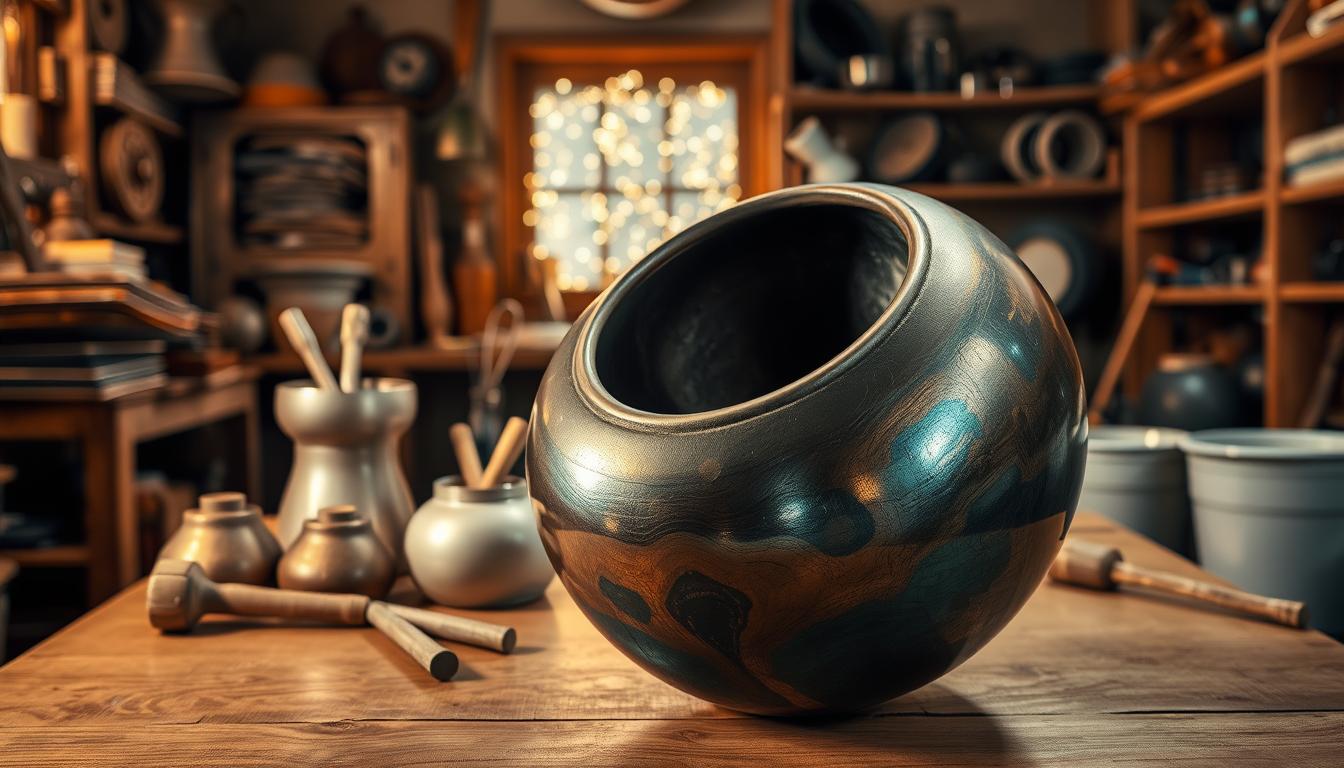

The handpan is a relatively new and highly sought-after instrument. Created in Switzerland in 2001, it quickly spread around the world. Today, there are more than 300 workshops worldwide, and the range of instruments has grown.
When buying one, quality often depends more on the maker than on a product listing. This guide explains how to compare makers, test an instrument, and avoid unpleasant surprises.
We offer practical criteria: tuning, materials, manufacturing process, after-sales service, and sound signature. Two handpans in the same range can sound very different depending on the maker. For demonstrations and local examples, visit the Shellopan collective.
Understand the handpan before buying: what every maker should master
Before buying, you need to understand what makes this instrument vibrate.
A handpan consists of two shells made of nitrided or stainless steel. The central Ding establishes the main pitch. Around it are hammered note fields. Beneath the instrument, the Gu affects resonance and projection.
Structure and sound-producing areas
The maker shapes each area by hammering. The precision of the strikes determines note stability. Uneven hammering creates unstable notes or buzzing.
Tuning and harmonics
Each note combines a fundamental with harmonics, often the octave and the fifth. Their balance creates the instrument’s sound signature.
Advice for beginners
Before buying, listen for even sustain, controlled increases in volume, and the absence of unwanted vibrations when the instrument is played softly.
For beginners, look for stable notes, a good balance between low and high pitches, and suitable sustain. The scale should feel naturally coherent as you move from note to note.
| Element | Positive sign | What the maker checks |
|---|---|---|
| Ding | Clear, stable pitch | Precision of the central hammering |
| Note fields | Consistent sound without buzzing | Placement and size of the hammered areas |
| Gu | Rich resonance and good projection | Opening size and acoustic treatment |
| Tuning | Balanced fundamental and harmonics | Fine adjustments and dynamic testing |
A good craftsperson explains these points without jargon. For practical examples and local testimonials, visit the Shellopan collective.
Why choose a handpan made in France today?
Buying close to where the instrument is made offers practical benefits. You can meet the maker, try several instruments, and get prompt answers to technical questions.
Buying locally also makes after-sales service easier: tuning adjustments, retuning, or refinishing can often be handled within a few weeks or months, depending on the workshop.
Local craftsmanship and quality
Carefully controlled handwork makes it easier to track the materials, production stages, and tuning tolerances.
The result: fewer surprises on delivery and straightforward traceability if a problem arises.
A rapidly developing market
The market has grown by 30% since 2020. Regions such as Occitanie, Brittany, and Île-de-France have seen respected workshops emerge, including Metal Sounds.
Customization and tailored support
Many workshops offer custom options: scales, note counts, finishes, or engravings suited to your playing style.
In practice, support can include adjustments, an extended tuning warranty, and service times stated in weeks.
For the local economy: a locally made instrument represents about 35 hours of work and supports a sector employing around 150 people. To find a local workshop and compare your options, contact makers directly.
Handpan makers in France: how to spot a good craftsperson
Trust starts with concrete evidence: a workshop address, a clear business identity, a SIRET registration number, an invoice, and written warranty terms. These details make it easier to pursue a complaint if needed.
Traceability and materials
Ask where the steel comes from, what type it is, how thick it is, and which treatment was applied: nitriding or an anticorrosion heat treatment. Whether the delivered product matches the maker’s description is an essential criterion.
Labels and quality indicators
The Artisan d’Art designation indicates a professional level of craftsmanship. Also check the stated tuning tolerances and quality-control procedures.
Process and quality checks
A good professional describes each stage: forming, hammering, fine tuning, intermediate checks, heat treatment, finishing, and final inspection. Metal Sounds, for example, describes 12 controlled stages, which is a useful indicator.
Services and questions to ask
- What type and thickness of steel do you use?
- What treatment do you apply, and what tuning warranty do you offer?
- What adjustments are possible after delivery?
Tip: an attractive website is not enough. Look for transparency, written evidence, and advice suited to your level and desired scale.
Materials: how to choose between nitrided and stainless steel
The choice of metal directly affects how the instrument responds to your fingers. Rust resistance is not the only factor: the material also affects attack, dynamics, and sustain.
Nitrided steel
Characteristics: corrosion resistance, a quick response, and an often warmer tone. Common thickness: 0.8 to 1.2 mm.
It suits rhythmic playing and frequent travel. With suitable care, it often lasts more than 10 years.
430 or 441 stainless steel
Characteristics: a brighter sound and longer sustain. Typical thicknesses: 1.4 to 1.8 mm.
It suits slow melodies and studio recording. Bear in mind that it can scratch and may require more careful maintenance.
Practical signs to check
- The stated thickness and consistency from one note to another.
- The finish: an even surface that is neither too rough nor too soft.
- The response to a light strike: immediate or delayed.
| Criterion | Nitrided steel | 430 or 441 stainless steel |
|---|---|---|
| Typical thickness | 0.8 to 1.2 mm | 1.4 to 1.8 mm |
| Sustain | Moderate, with a quick response | Long and pronounced |
| Maintenance | Simple; good resistance | More demanding; prone to scratches |
| Recommended use | Touring performances, rhythmic playing | Studio work, slow ambient music |
A simple rule: choose the material that suits your music and environment. To see examples and compare local workshops, consult the listed workshops.
Scale, pitch, and number of notes: the choices that make all the difference
An instrument’s sound palette depends first on its scale and number of notes. These choices determine its mood, how easy it is to improvise, and how well it works with other musicians.
Popular scales and their uses
Among the scales popular in France, D Kurd remains a recommended choice for beginners: it is versatile and makes improvisation easier.
The Celtic Minor scale creates cinematic moods. The Pygmy scale offers an intimate sound. Eastern-inspired scales such as Zaora add harmonic tension.
Number of notes: what changes?
The number of notes affects the sound palette and the complexity of tuning. More notes bring more possibilities, but also a higher price and greater maintenance needs.
For beginners, the safest configuration has 9 notes: 8 notes plus the Ding. That is enough to learn without feeling overwhelmed.
Pitch standard: 440 Hz or 432 Hz
A 440 Hz tuning reference makes group playing and music production easier. A 432 Hz reference is often chosen for personal or therapeutic use, but it complicates group sessions.
- Buying tip: choose a scale that sounds good even when played with simple movements. This choice supports progress and helps prevent an impulse purchase.
- Choose a common scale if you expect to play with other musicians or attend workshops: it makes it easier to connect with the community and the wider world of musicians.
For exercises and techniques involving high notes, also consult this resource.
Quality test: how to assess an instrument in minutes, even as a beginner
A few minutes of listening can reveal the most troublesome sound defects.
Listening checklist: play each note softly, then more firmly. Listen to the sustain: aim for at least 5 seconds on a well-sustained note. Check the purity of the sound and listen for buzzing or unwanted metallic vibrations.
Consistency: compare the volume and tone of the notes. Transitions should sound natural. If a note seems “out of place,” the tuning or hammering may be faulty.
Balance test: play simple arpeggios spanning low and high notes. Observe the dynamics: you should be able to increase the volume without notes distorting or disappearing.
Physical signs: careful polishing, even note fields, and a stable Ding without unusual wobbling. There should be no visible defects or hairline cracks.
“A few minutes of testing are often enough to rule out most problematic instruments.”
When to seek an expert opinion: when buying second-hand, if you doubt the tuning, or when buying remotely. A handpan specialist or tuner’s assessment costs about €80. Retuning every 2 years is a cautious starting point, depending on use, and a good seller should be able to recommend this service.
| Check | Expected result | Action |
|---|---|---|
| Sustain | At least 5 seconds after a normal strike | Rule out the instrument if sustain is under 5 seconds |
| Noise and buzzing | No unwanted vibrations | Ask for an adjustment or an expert opinion |
| Consistency | Coherent volume and tone | Compare several notes with one another |
| Finish | Even polishing and regular note fields | Reject the instrument if defects are visible |
Practical tip: if you cannot try the instrument in person, ask the seller for unedited videos of individual notes and arpeggios. Use the same test for every instrument so you can compare their sound fairly.
Handpan prices in France: a realistic budget, options, and second-hand instruments
Prices vary widely according to the care taken at every stage of production. Before buying, set a realistic budget and consider the total cost: the instrument, accessories, and maintenance.
Typical price ranges
Entry level: about €800 to €1,500 for simple instruments suitable for getting started.
Mid-range: about €1,500 to €2,500 for better tuning stability and careful finishing.
Custom premium instruments: from €3,000, sometimes over €4,000, for special options, rare scales, finishes, and personalized support.
Why prices rise quickly
Labor accounts for about 60% of the cost: forming, hammering, and fine tuning take time.
Materials and their treatments account for about 25%, and research and development for around 15%. Adding notes increases tuning time and can raise the price by about 20% once the instrument has more than 10 notes.
Second-hand or new
Buying second-hand reduces the initial cost, but problems may be hidden: unstable tuning, hairline cracks, or an unknown history.
If you buy second-hand, request proof of origin, detailed photographs, videos of every note, and, if possible, an inspection or retuning by a tuner before completing the purchase.
Additional costs and lead times
- Case: €150 to €300
- Stand: about €80
- Insurance: about €50 per year
- Retuning or adjustment: about €80 per service
Finally, factor in lead times: depending on the workshop, delivery can take weeks or months. Allow for this time if the purchase is connected to an event or project.
“A quality instrument costs more, but it can save time and adjustments in the long run.”
| Price category | Indicative price | What you get |
|---|---|---|
| Entry level | €800 to €1,500 | A simple instrument, sufficient for beginners |
| Mid-range | €1,500 to €2,500 | Stable tuning and better finishing |
| Custom premium instrument | From €3,000 | Customization, scale choice, support, and premium finishing |
Where to buy a handpan in France: workshop, specialist dealer, or shop
Where you buy determines whether you can try the instrument, the support you receive, and how much confidence you can place in the seller.
Buying directly from the maker
Benefits: an appointment to try several instruments, a choice of scale and finishes, and direct contact for ongoing support.
Always ask for written terms covering the warranty, tuning adjustments, which some workshops offer free for 2 years, and lead times. Make an appointment and take note of care instructions.
Shops and retail outlets
Trying instruments in person lets you compare their tone and sustain immediately. Woodbrass in Paris and Djoliba in Toulouse, for example, offer the reassurance of face-to-face contact.
Sales staff can offer quick advice, accessories, and opportunities to try instruments.
Specialist online platforms
Sites such as Handpan.World and MyPan Marketplace offer a wide selection, certificates, and detailed listings. Look for videos of each actual instrument and proof of authenticity.
Online buying rule: do not buy without videos of the actual instrument showing the Ding, the Gu, and every note played separately.
“An unusually low price, below about €800, is a warning sign; ask for evidence and documentation before paying a deposit.”
| Buying channel | Main benefit | Drawback |
|---|---|---|
| Direct from a workshop | Customization and ongoing support | Possible production lead times |
| Shop | Immediate trial and advice | Selection depends on stock |
| Online platform | Wide selection and warranties | Risk of generic images; checks are needed |
Before paying: check the seller’s identity, SIRET number, address, return terms, and whether the information provided is consistent. Do not pay a deposit without a clear contract.
Beware of counterfeits and scams: signs of a poor handpan
An offer priced too low should raise concerns. The market attracts cheap copies and opportunistic sellers. Take the time to check each listing and ask for concrete evidence.
Counterfeits: common clues
An unusually low weight may be a sign of a counterfeit.
When played, the notes may sound hollow or lack balance between the fundamental and its harmonics.
Online scams
On online platforms, watch out for stolen photos and overly generic reviews. Run a reverse image search and check whether duplicate listings are consistent.
Poor quality: visible signs
Symptoms include unstable tuning, a metallic sound, recurring buzzing, early oxidation of the steel, and defects in the note fields.
- For a second-hand instrument, ask for its history and videos of every note, and check for hairline cracks.
- Choose secure payment methods and request an invoice and written return terms.
- If the seller refuses to provide evidence, walk away, even if the price seems attractive.
“An unusually low price often conceals poor quality or faulty tuning.”
Finally, take the time to choose: this instrument is judged by details that photographs cannot reveal. To set your budget, consult a guide to a realistic price.
Conclusion
To make your choice, follow a clear process. First, define how you will use the instrument, then choose the right scale and number of notes.
Next, assess quality through a listening test, especially sustain and the absence of buzzing, and a visual inspection. Give priority to stable tuning and balanced harmonics over appearance.
Compare several instruments at a workshop, in a shop, or through reliable videos. Direct contact with the workshop makes after-sales service, adjustments, and traceability easier.
Finally, budget for the full cost: accessories and maintenance help extend the instrument’s life. Ask the right questions about nitrided steel, the manufacturing process, and warranties before buying.
Final tip: take your time. These criteria will help you find a durable, inspiring instrument for your music.