
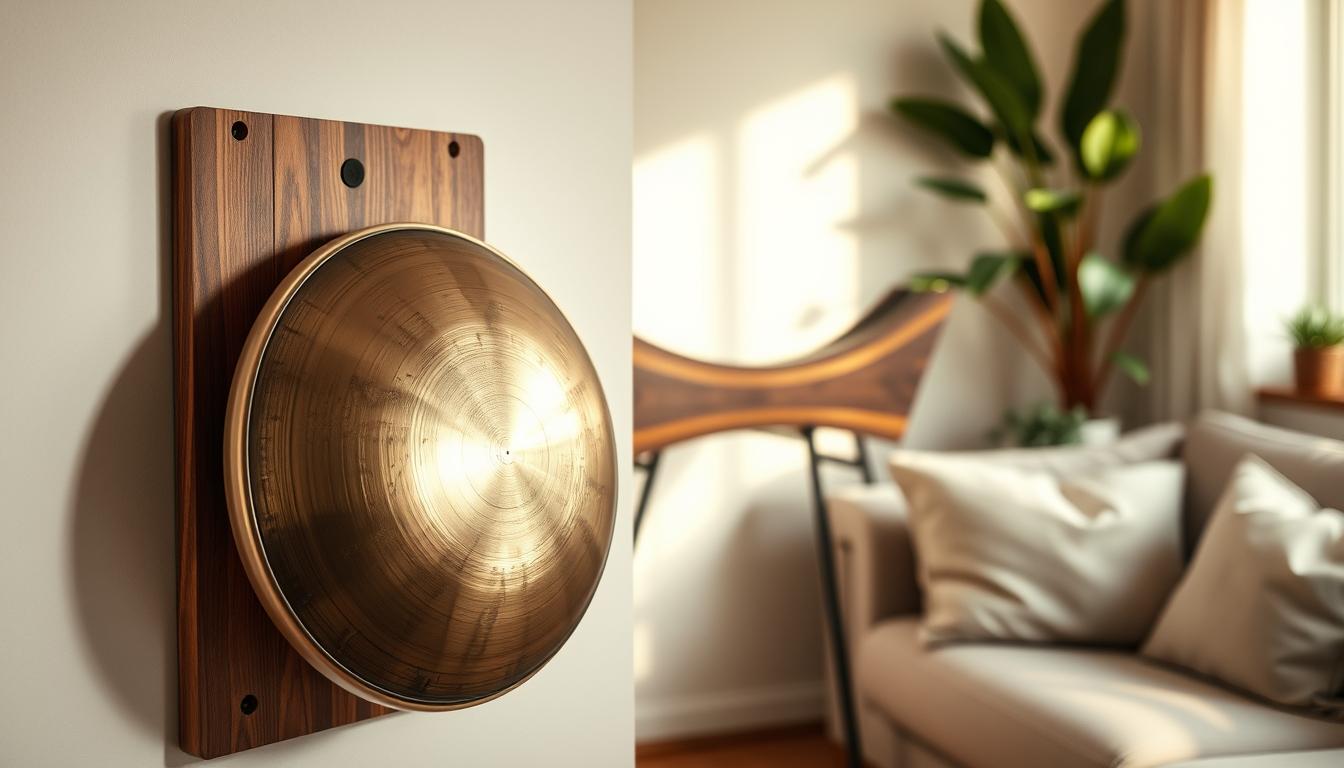

A practical choice, but one with consequences. The handpan is a delicate instrument, often purchased for between €500 and €700. Most damage occurs during storage and transport (around 80%).
Mounting your handpan on a wall can free up space and make it easier to play. However, without a suitable mount, humidity, impacts or poor installation increase the risks.
This guide compares two options: wall mounting and floor-based solutions (stands, shelves and tables). We assess safety, protection, playing quality and everyday convenience.
You will find a clear summary to help you decide based on your home, your habits and risk factors (children, pets and walkways). The key criteria are stability, padding, material quality and the environment (humidity, heat and salty air).
What you will get: concrete examples of specialist hooks, a checklist to use before buying and common mistakes to avoid. For more advice on storage and protection, see our detailed article.
How a handpan is supported often determines its lifespan and everyday playability.
This choice is more than a minor accessory detail. It affects protection from scratches, dents and loss of tuning. It also influences ergonomics and playing quality.
The best models are made of treated steel: they are robust, but not invincible. Repeated minor impacts and rubbing can weaken the shell and affect tuning accuracy.
Material and vulnerability
An instrument made of treated steel withstands use better. But prolonged exposure to moisture or salt, or impacts without enough cushioning, calls for regular care.
Where most damage occurs
Key statistic: around 80% of damage occurs during storage and travel. Unsuitable cases, stacking and hurried handling are responsible.
Stability, sound and comfort
An unstable support produces unwanted vibrations. This reduces tuning accuracy by around 5% and makes playing less consistent.
| Risk | When | Consequence |
|---|---|---|
| Minor impacts | Storage | Scratches, partial loss of tuning |
| Moisture and salt | Outdoor travel | Corrosion, increased maintenance |
| Instability | Everyday playing | Unwanted vibrations, reduced sound quality |
A good support and suitable accessories are not an unnecessary expense: they help keep the instrument safe and are a long-term investment. The next section compares wall mounting with floor-based solutions.
Wall mount for a handpan: good idea or risk to the instrument?
Hanging your handpan on a wall lets you display it elegantly while keeping it within easy reach.
The advantages at home: a mount frees up floor space, shows off the instrument and makes it easy to use without opening a case each time. The instrument can also “breathe” better than it would in a bag, provided the room stays dry and ventilated.
The real risks: side impacts in a hallway, an inadequate fixing that could allow it to fall, or contact points that are too hard and mark the shell. Humidity and salty air call for extra vigilance and, sometimes, a hard case with a moisture absorber.
When this option makes sense: in a dedicated room, away from walkways, out of reach of children and pets, with clear rules for use and storage.
| Benefit | Risk | Recommended solution |
|---|---|---|
| More space, quick access | Falling if the anchoring is inadequate | Specialist hook (HardCase Technologies, Artful Steel) |
| Attractive display | Marks on the shell | Padded contact points, scratch-resistant accessories |
| Better airflow than in a case | Problems caused by salty or humid air | Hard case with a moisture absorber |
In short: when chosen well, a wall mount protects the instrument and makes practice easier. For detailed storage and protection advice, see our guide to storage and protection. The next section compares this option with floor-based solutions.
Option A: the wall mount — what to check before buying
The right choice depends on mechanical safety, protection of the shell and the room environment.
Strength and safety
Checklist before buying:
- Wall type (solid or plasterboard) and the quality of the wall anchors.
- Number of anchor points and load capacity, with a safety margin.
- Accessible screws that can be checked regularly.
Protecting the shell
Choose thick, non-abrasive padding. Wide contact areas prevent concentrated pressure and dents.
Materials and placement
Metal: strong, but it can resonate. Wood: attractive and stable, though often heavier. Rubber: excellent cushioning, but check it for wear.
| Material | Characteristics | Indicative price |
|---|---|---|
| Metal | Strong, possible vibrations | $50 to $150 |
| Wood | Stable, heavy | $80 to $200 and up |
| Rubber or foam | Cushions impacts, wears over time | $60 to $120 |
Avoid heat sources (radiators and fireplaces) and areas exposed to salty air. Monitor humidity and check the fixings over time.
Practical rule: even when mounted on a wall, the instrument needs a bag or case for travel, as well as a hard case with a moisture absorber if salty air is likely.
Option B: alternatives to wall mounting (floor, stand, shelf and table) — comparing their uses
Freestanding solutions often offer more stability and flexibility than a wall mount. They let you place the instrument away from walkways and reduce the risk of a failed wall anchor.
Floor stand: a benchmark for stability while playing. A sturdy stand with non-slip feet keeps the instrument still. It is the best choice for rehearsing, recording or performing.
Adjustable tripod
A tripod lets you adjust the height and angle. It works for playing while seated or standing. Katanui and Art-of-Impro models are recommended for their warranties and precise adjustments.
Lap support
Compact and lightweight, it is easy to take with you. It is ideal for travel or a mobile studio. Bear in mind that it is less comfortable during long sessions.
Dedicated or DIY shelf
A shelf fitted with cushions (for example, an Ikea shelf with foam) creates a safe music corner. It is an inexpensive solution that limits impacts and helps organize the space.
Sturdy table with a cloth
A simple, economical option: a stable table protected by a cloth or thick mat. It is practical if you do not want to invest in accessories immediately.
“There is no single right choice, but several solutions depending on your needs and how often you use the instrument.”
| Option | Advantage | Disadvantage |
|---|---|---|
| Floor stand | Maximum stability, ideal for playing | Takes up floor space |
| Adjustable tripod | Adjustable height and angle, versatile | More expensive, needs adjustment |
| Lap support | Portable, takes up very little space | Less comfortable during long sessions |
| Dedicated or DIY shelf | Organized space, low cost | Less ergonomic for playing |
For practical care and storage advice, see our guide to handpan care.
How to choose a good handpan support (quality, ergonomics and protection)
Good support improves playing and limits the minor impacts that put an instrument out of tune. Choosing a support comes down to simple, concrete criteria: height, angle, stability, padding, materials and ease of maintenance.
Height, angle and posture
Height guidelines: < 1.65 m: 45 to 50 cm; 1.65 to 1.80 m: 55 to 65 cm; > 1.80 m: 70 cm and up.
Playing while seated calls for a lower height. Playing while standing requires a greater height to avoid strain in the shoulders and wrists.
Angle matters: if it is too shallow or too steep, some notes become hard to reach and playing becomes less consistent.
Stability and non-slip features
Choose a wide base, non-slip feet and a support that does not tip over. Test its stability with a gentle push before each session.
Poorly controlled vibrations can reduce tuning accuracy by around 5%, which is why stability matters.
Padding and materials
Rubber absorbs impacts better; metal provides strength; wood combines stability with an attractive appearance.
Check screws and parts for wear, and choose quality models (for example, Katanui or Art-of-Impro) that come with a warranty.
| Criterion | What it provides | What to check |
|---|---|---|
| Height | Comfort, access to notes | Recommended range for your height |
| Stability | Fewer vibrations, greater safety | Non-slip feet, gentle push test |
| Padding | Shell protection, impact cushioning | Non-abrasive material, thickness |
| Materials | Durability and resonance | Suitability for humidity and intended use |
Everyday safety: protective habits and mistakes that damage a handpan
A few steps before and after each session prevent most problems.
What to avoid while playing: remove rings, bracelets, necklaces and any belt buckle. A small scratch can affect the tuning of a precisely tuned instrument.
Microfiber cloth: always wipe both sides after each session. From time to time, also wipe the inside to remove any remaining moisture.
Never put a damp handpan in a bag or case. Storage in a damp environment speeds up rust and damages coatings. Let the whole instrument dry in the room for at least an hour, away from a radiator or fireplace.
Do not store the instrument upside down. Prolonged pressure on the ding causes it to go out of tune. If you need to turn the instrument over to clean it, place it on a thick, soft support for only as long as necessary.
In humid or coastal areas, choose a hard case or a dry cabinet and add a moisture absorber. Check that everything is completely dry before closing it.
| Action | Why | How often |
|---|---|---|
| Remove jewelry | Prevents permanent scratches | Before every session |
| Wipe with a microfiber cloth | Removes sweat and moisture | After every session |
| Do not store the instrument while damp | Prevents corrosion | Always |
| Store the instrument with the top facing up | Prevents pressure on the ding | Always |
Simple routine: a quick visual inspection, a wipe, then storage in a dry place. For more information, see our additional advice on storage and protection.
Travel and outdoor use: support or case, and risky environments
Taking your instrument outdoors requires as much care as playing it.
Quick comparison: a stand at your destination makes playing easier, but does not protect the instrument in transit. Safe transport depends on a reliable case, ideally a hard case.
Handling rules
If you need to carry the instrument without a bag: grip it firmly from inside the gu and move slowly, avoiding obstacles. This reduces impacts and the chance of slipping.
Choosing a case
Soft case: suitable for short journeys in calm conditions. Hard case (Evatek, Namana, Panji): recommended for long trips, busy places or travel. Consider both comfort and protection.
Risk factors
Ground: abrasion from sand or gravel. Humid air: corrosion if the instrument is not dried properly. Heat and sun: deformation and loss of tuning. Water: the inside must be dried before closing the case.
Practical advice: take a microfiber cloth, wipe the instrument several times and never put it into a damp bag. Before long outings, apply a thin layer of oil (for example, Phoenix oil) for extra protection.
At the beach: salt, humidity and sand are the worst combination. Keep the bag open for as little time as possible, clean the instrument when you return (using alcohol for stains), then wash the cloths. These steps can help you avoid repairs.
Conclusion
In short: the right choice accounts for safety, quality and how you actually use the instrument. A wall mount is suitable if the fixing is secure, the location is away from walkways and the environment is dry.
If your home presents risks (children, pets or busy hallways), choose a floor-based solution: a tripod, shelf or table offers more stability and playing comfort.
Keep the universal criteria in mind: build quality, non-abrasive padding, stability and suitable materials (wood, metal and rubber). Do not forget maintenance: wipe with a microfiber cloth, let the instrument dry and store it with the top facing up.
Simple next step: compare two or three models, check their load capacity and reviews, then prioritize quality over a low price. The goal is to keep your handpan safe and make playing more enjoyable in the long term.