
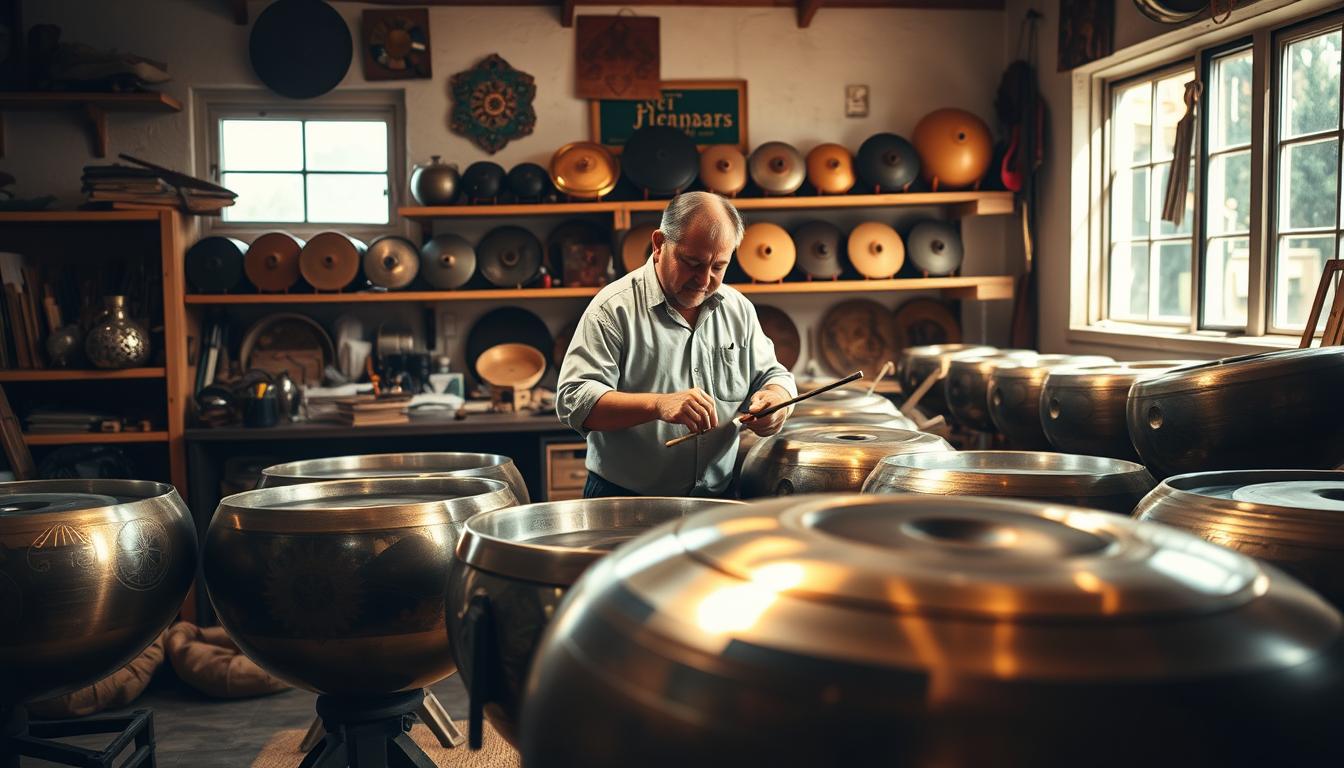

Background: The market has changed considerably since the days of PANArt’s Hang®. Today, there is a wide range of options, and the choice can seem confusing.
In France in 2026, choosing an instrument means considering its sound, your budget, the wait time, and resale value. Waiting lists have sometimes stretched to several years, but availability varies by maker and by flash sale.
What this guide offers: this guide aims to give you a clear, practical resource. You will learn the terminology, quality criteria, and marketing traps to watch for before making a purchase.
The goal is simple: to help you choose an instrument suited to meditation, percussion, studio work, or outdoor playing. We will cover tone, sustain, tuning, materials, scales, note count, pitch standard (432 or 440 Hz), price, and lead times.
Before buying, listen, compare, and try instruments if possible. Verify the maker’s identity and plan for maintenance and retuning to reduce the risk of scams.
Understanding the handpan before buying: the instrument, ding, gu, and resonating chamber
Its shape and resonating chamber largely explain the instrument’s sound. It is an idiophone made from two joined metal shells that enclose an internal space. This construction creates an air chamber that contributes to projection and sustain.
Why it appeals to beginners and musicians
For beginners, playing is intuitive: resting on the lap, the instrument invites exploration without requiring music theory. Its fixed scale reduces wrong notes and brings quick satisfaction.
For experienced musicians, it rewards refined touch. Players can vary the tone, play polyrhythms, and control sustain to create complex nuances.
What the two-shell construction changes
The ding, the central note, provides a tonal anchor. The gu, the opening underneath, affects bass and resonance. Together, they influence note stability and harmonic coherence.
“Two instruments with the same scale can reveal very different sound worlds depending on the steel, the maker’s touch, and the finish.”
| Component | Role | Effect on tone |
|---|---|---|
| Ding | Tonal center | Clarity and fundamental pitch |
| Gu | Resonance opening | Bass and the sound’s “breathing” quality |
| Shells | Resonating chamber | Projection, sustain, harmonic coherence |
To learn more about construction and makers, see this article with useful resources: construction and techniques.
Who does what in the handpan world: makers, tuners, sellers, and the community
Each participant affects your confidence when buying and the instrument’s longevity.
Makers and tuners: the maker’s role in final quality
Makers design, shape, and tune the instruments. They control tuning consistency, long-term stability, and the final sound.
A good maker ensures clean shoulder tones, comfortable playing, and support for retuning.
Organizers, associations, and workshops: where to try and learn in France
Local workshops, festivals, and associations let you try several instruments in a short time.
Look for introductory sessions, regional gatherings, and lessons to refine your choice.
Also consult online resources and directories, such as workshops and resources, to find events near you.
Marketing, craftwashing, and scams: why information protects you
The sector also attracts rebranding, sellers who disclose little, and dropshipping. Be wary of claims that a product is “handmade” without evidence.
“Prioritize traceability: the maker’s name, serial number, certificate, and history.”
- Signs of craftwashing: unclear origins, heavily edited videos, and vague after-sales support.
- Ask questions, request unedited demonstrations, and compare several sellers.
- Consult the community to check your choice and save time.
Essential terminology for buying with confidence
Knowing a few technical terms makes it easier to compare listings and talk with a maker. This short glossary helps you recognize an instrument’s real value.
Terms and names
The usual term is handpan, sometimes replaced by pantam. Avoid using “Hang” as a generic name: it belongs to PANArt.
Parts and harmonics
Dimple: a small indentation that helps form a note. The ding is the central note area. The gu is the opening under the instrument.
What to listen for
Bottom notes: notes on the underside of the instrument that add depth in the low register.
Shoulder tones: higher overtones around the center, crucial for percussive playing.
Sustain, dynamics, and coupling
Sustain describes how long a vibration continues. Decay describes how the note fades away.
Dynamics describe the response to strong or gentle strikes. Beating and coupling create textures that may be desirable or distracting.
“Listen to the shoulder tones and sustain: they often reveal the instrument’s true quality.”
New, handmade, or mass-produced: how these options affect quality, price, and lead time
How an instrument is made often determines its character, lead time, and price. Assess what you get for your money in sound, stability, and ongoing support.
Handmade: time, tone, and personality
Slow production: the process takes time and requires adjustments with a hammer. The result often has carefully shaped harmonics and a distinctive personality.
Advantage: distinctive sound and careful finishing. Drawback: longer waiting lists and variation between instruments.
Mass production: consistency and points to watch
Mass production aims for repeatability. Instruments are more alike and are made faster.
Check the final sound and quality control. A fast production pace can sometimes let tuning inconsistencies through.
New instruments: warranties, support, and retuning
A new instrument often comes with a warranty and a retuning policy. Ask about the terms: duration, costs, and how future adjustments are handled.
That adds reassurance when buying, especially if you plan to play regularly or resell later.
When buying used makes sense
A used instrument may offer the best value if your budget is tight.
Consider this option if the instrument has already proved stable and you can try it. Ask about its history and test it thoroughly.
“Price does not always correspond to quality: you can find excellent instruments around €1,200 and disappointing ones at €2,500.”
A simple rule: choose the best balance of quality, price, and lead time for your needs, without relying on marketing promises.
How handpans are made and why some instruments sound alike
Construction generally has three stages: shaping, tuning, and final sound finishing. Each stage takes time and skill.
Shaping: entirely by hand or with preformed shells
Shells can be hammered and shaped by hand. This gives them character and makes each piece unique.
Preformed shells improve consistency. They reduce production time but can make the sound more uniform.
Hammer tuning: why it remains slow, manual work
Each note is tuned with a hammer. Even with modern aids, precision depends on manual work.
This takes time and partly explains the price. Precise work stabilizes the harmonics.
Sound finishing: the stage often neglected in high-volume production
Finishing stabilizes and balances the harmonics and removes unwanted noises. Without it, the instrument is less enjoyable to play.
High-volume production sometimes cuts back on this stage. The result is similar instruments with a narrower range of tonal colors.
“Identical templates and shared materials can make different models sound uniform.”
| Stage | Process | Effect on sound |
|---|---|---|
| Shaping | Hammering or pressing | Character or consistency |
| Tuning | Hammer adjustments | Harmonic precision |
| Finishing | Stabilizing and balancing | Quality and removal of defects |
Before buying, check that the notes are consistent and that no troublesome coupling occurs. To understand the process better, see understanding the instrument.
Quality criteria to check before buying: sound, stability, and playing enjoyment
A careful examination of tone and stability often reveals an instrument’s true value. Listen through headphones if possible. Hear each note separately and check its actual pitch rather than relying on an overall impression.
Tuning and harmonics
Check the fundamental, octave, and fifth of every note. Confirm the actual tuning: a note that sounds “pretty” can still be out of tune.
Shoulder tones and sustain
Shoulder tones: listen for them by gently striking near the center. Their tuning changes the percussive sound.
Sustain should be consistent: short, medium, and long sustain each have advantages. Avoid a muddy wash of sound when too many resonances overlap.
Dynamics, balance, and coupling
Test the dynamic response from pianissimo to fortissimo. Good steel responds well without going out of tune.
Assess the balance: even volume and tone, or a more pronounced character, depending on your taste.
Listen for troublesome beating: it can be musical or sound unstable.
Finish, comfort, and resale
Check the rim, the gu, the absence of unwanted noises, and the surface condition. Identify the maker to make after-sales service and resale easier.
| Criterion | What to check | Why it matters |
|---|---|---|
| Tuning | Fundamentals and harmonics | Pitch accuracy and musicality |
| Shoulder tones | Presence and tuning | Percussive quality |
| Sustain | Duration and clarity | Balance between richness and a muddy wash of sound |
| Dynamics | Response to changes in touch | Expressiveness |
| Finish | Rim, gu, surface | Comfort and longevity |
Choosing the material: how do nitrided steel and stainless steel differ in sound and care?
The material affects the playing feel, sound, and maintenance. Before buying, consider how you plan to use the instrument: outdoors, in a studio, for percussive playing, or for meditation.
Nitrided steel: clear attack and cascading decay
Nitrided steel offers a clear attack and a wide dynamic range. Its cascading decay leaves space between notes.
Advantage: rhythmic clarity and precision. Point to watch: sensitivity to moisture and the need for regular care, such as cleaning and waxing.
430/441/4xx stainless steel: long sustain and warmth
Stainless steel offers longer sustain and a warmer sound. Its tone can seem denser and more stable over time.
Although less prone to oxidation than nitrided steel, it should still be wiped after use to limit marks and moisture.
Which material suits your needs?
Outdoors: favor projection and dynamics (nitrided steel). In the studio: favor control over resonance (stainless steel).
For percussive playing: nitrided steel for precision. For meditative playing: stainless steel for a longer-lasting bed of sound.
Always listen to both materials through headphones and in person: the difference in tone and sustain is immediately apparent.
Practical rule: the material shapes the playing feel, sound, and required care. Store the instrument somewhere dry and wipe it after every use.
Which scale should you choose for a first handpan?
The scale you choose largely determines the emotional color of your playing.
The scale frames improvisation: it offers a range and a sound world, rather than simply a tool. Choosing one means adopting a sound for your practice and music.
Minor, major, and distinctive modes
A minor mode often sounds introspective. A major mode tends to sound brighter and more direct.
Modes described as “Eastern” have distinctive colors. They can be beautiful but sometimes hard to combine with other instruments.
Why D minor is recommended
D minor remains a common reference point. Many instruments are offered in this scale. That makes comparative listening and finding tutorials easier.
Confusing scale names
Some makers use marketing names. Always ask for the tonic and the exact list of notes to avoid confusion about the name.
A guided approach to choosing what you love
- Listen to plenty of recordings through headphones to hear tone, sustain, and balance.
- Write down the scales you like and compare several examples of the same scale.
- Request a demonstration of the exact instrument before making a final decision.
Finding an instrument you truly love comes after comparison, not after watching a single recording.
432 Hz or 440 Hz tuning: playing alone, in a group, or in a holistic setting
Your tuning choice directly affects compatibility with other musicians and your intended use.
440 Hz is the standard that makes playing with a piano, guitar, or orchestra easier. If you plan to perform, record, or join jam sessions, this setting makes it easier to fit in.
432 Hz may be preferred for meditation or sound baths. It is a personal choice often requested for holistic practices, but it makes playing with instruments tuned to 440 Hz more difficult.
Practical examples: solo playing at home, yoga, or relaxation (432 Hz); or jam sessions, concerts, and recording with several instruments (440 Hz).
Good practice: decide before buying. Tuning affects resale and your ability to add other instruments later.
Always check that the seller or maker clearly states the tuning on the product listing or certificate. For a deeper look at the decision, consult this buying guide.
| Tuning | Typical use | Advantage and limitation |
|---|---|---|
| 440 Hz | Jam sessions, studio, concerts | Advantage: compatibility; Limitation: less tailored to holistic practices |
| 432 Hz | Sound baths, yoga, solo listening | Advantage: gentle atmosphere; Limitation: harder to combine with other instruments |
| Recommendation | First purchase in France | Practical choice: 440 Hz for more flexibility; 432 Hz may suit particular uses |
Number of notes: are 9, 10, or more really harder to play?
The number of notes directly affects musical range and how you play.
A common misconception: more notes do not automatically make an instrument harder to play. They do require more familiarity with the layout, greater precision, and sometimes better sustain control.
Nine-note format: the most common starting point
The nine-note format remains the standard. It is ergonomic and simpler for learning quickly.
It offers a good balance between tonal range and an easy-to-read layout. Makers offer plenty of options, making comparisons easier.
Ten or more notes: range, complexity, and cost
Instruments with ten or more notes offer an extended range. They allow richer arrangements and more sophisticated harmonies.
In return, prices and lead times increase. You also need more skill to make full use of the additional notes.
When more notes inspire you—and when they are too much
Watch out for cognitive overload: a beginner may rarely use some of the notes.
Practical criterion: choose more notes only if you have a specific goal, such as composition, accompaniment, or access to higher and lower pitches.
“Always compare demonstrations of nine-note instruments with those of instruments with ten or more notes to judge the real benefit.”
| Number | Advantage | Limitation |
|---|---|---|
| 9 notes | Ergonomics, quick learning | Limited but effective range |
| 10 to 12 notes | Wider range, more harmonics | Higher cost, more notes to locate |
| 13 or more notes | Broad range for composition | Risk of rarely using some notes |
Budget and price: how much does a good handpan cost in France in 2026?
Setting a budget for today’s French market helps avoid disappointment. In 2026, most instruments fall between €1,200 and €2,500. This range covers roughly 90% of observed sales.
Realistic price ranges
Consider €1,200 to €1,600 a reasonable entry-level range for good value. Between €1,600 and €2,500, you will find more refined finishes and options, such as a greater number of notes or specialized treatments.
Why prices vary
Several factors raise the price: the time spent tuning, sound finishing, number of notes, scale complexity, the maker’s reputation, and a rare range or material.
Price and quality: spotting the traps
A high price does not guarantee better quality. Sometimes it reflects marketing or artificial scarcity.
- Listen to several comparable instruments.
- Check tuning, balance, and dynamics.
- Compare independent views from the community.
| Factor | Effect on price | What to budget for |
|---|---|---|
| Tuning time | Significant | Included |
| Number of notes | Moderate | According to your needs |
| Rarity and reputation | Variable | Can raise the price |
A stable, musical instrument within your budget is better than a “prestige” item that is hard to play or resell.
Lead times, waiting lists, and flash sales: how to get an instrument without stress
Lead times can turn buying an instrument into a lesson in patience. Some makers have waiting lists of several months, occasionally one to three years. Others offer flash sales on their websites or social media. Some models are available immediately from certain retailers.
Waiting lists: ways to manage the wait
Sign up early and ask for a realistic delivery estimate. Stay flexible about the scale and material to reduce the wait.
Favor written communication and keep confirmations. This helps you avoid vague promises and track progress.
Preparing for flash sales
Follow the maker’s channels and turn on notifications. Decide on your budget and scale in advance so you can act quickly.
Have your payment details ready and plan for delivery. Simple preparation improves your chances during a flash sale.
When a maker does not reply: keep a backup plan
Silence is not always a bad sign, but protect yourself. Follow up politely and set a deadline for a reply.
Identify two or three other reliable makers. This shortlist helps you avoid buying an instrument under pressure simply because it is available.
“The best choice takes time: rushing often leads to regret.”
Where to buy a reliable handpan: makers, online sellers, shops, and festivals
Where you buy affects your relationship with the maker, your chance to try the instrument, and how clear the after-sales service is.
Buying directly from a maker
Advantage: you can try the instrument and discuss the scale, steel, and tuning in person.
The conversation lets you assess ongoing support, retuning lead times, and traceability.
Buying online
Require demonstrations of the exact instrument, proof of origin, and clear return terms.
Be wary of heavily edited recordings and listings that do not name the maker.
Shops in France
Trying an instrument in person gives you an immediate reference point. Check the tuning note by note instead of relying only on your overall impression.
Festivals and gatherings
These are ideal places to compare several models, materials, and scales quickly. Make a note of the sounds you prefer.
Maker directories
A directory helps you shortlist instruments by price, scale, and lead time. Base your final decision on listening and traceability.
“Listen to trustworthy demonstrations and always ask who made the instrument before confirming a purchase.”
| Buying channel | Advantage | Limitation |
|---|---|---|
| Direct from the maker | Customization, trying it, ongoing support | Possible waiting time |
| Online | Wide choice, quick comparisons | Risk of unclear provenance |
| Shop | Immediate trial, local advice | Limited stock |
| Festivals | Compare several instruments quickly | Variable acoustic conditions |
Buying a used handpan: good deals, checks, and common traps
Finding a good used instrument takes a methodical approach: a few checks and focused questions help prevent unpleasant surprises.
Why an in-person trial remains essential
Nothing replaces trying it yourself. Play every note and check the tuning and sustain.
Listen for unwanted noises, inspect the surface, and look for signs of oxidation.
Questions to ask the seller
- Purchase date and the maker’s name.
- Record of work done: dates and reasons, including retuning, impacts, and maintenance.
- Whether it is tuned to 432 or 440 Hz, and its repair history.
- Ask for a receipt or certificate, if available.
Photos, recordings, and platforms
Require dated photos and a recording that proves the seller has the instrument and shows what it really sounds like.
Beware of listings that seem too good to be true: an unusually low price, urgency, and refusal of a video call or trial are warning signs.
An instrument with a documented history is easier to resell and to have retuned by its maker.
For resale, identifying the maker makes all the difference. Complete documentation, including the receipt and maintenance records, makes the transaction safer and preserves value.
Payment, delivery, and transport: secure the transaction and protect the instrument
Agreeing on who pays, when, and how helps prevent many disputes after the sale.
Payment arrangements and protection
Deposit: common when reserving an order or a place on a waiting list. It shows the buyer’s commitment but calls for a clear invoice and a written delivery estimate.
Payment when the instrument is ready: this arrangement protects the buyer, who pays the balance once the seller has checked the instrument and it is ready to ship.
Payment before shipping: this can be acceptable if the seller provides tracking, proof of dispatch, and a return policy. Always ask for the terms in writing.
Packaging and shipping
Favor a sturdy case, double packaging, and internal padding that holds the instrument still.
Require shipping insurance and a tracking number. On delivery, take photos and a video if the package is damaged.
Costs and logistics
Include shipping in the total price before deciding. Sometimes collecting the instrument in person costs less and reduces the time you have to wait.
Collecting in person
Picking up the instrument allows one final trial and creates a direct relationship with the maker. It is often the best way to secure good after-sales support.
It is better to wait for a reliable seller than to give in to a high-pressure offer that could lead to repair costs.
For an example of checks to make when buying used, see this practical guide: checks for a used instrument.
Care, oxidation, and after-sales service: preserving sound quality over time
Preserving sound quality takes simple, regular care after every session. The goal is to limit oxidation, protect the steel surface, and keep the tuning stable.
Wiping, cleaning, and waxing according to the material
Always wipe the instrument with a dry cloth after playing. Skin contact and moisture encourage oxidation.
For nitrided steel, clean it as the maker recommends and apply a suitable protective wax or oil. This protects the finish.
Stainless steel is more forgiving but should still be wiped regularly; it is not “maintenance-free.”
Moisture, storage, and prevention
Store the instrument in a breathable case, away from damp basements and hot cars. Check the surface regularly.
Retuning and after-sales service
Retuning affects quality and long-term cost. Not every maker offers the service.
Favor a seller with clearly defined after-sales support: stated availability, lead times, and costs make maintenance easier.
A well-maintained instrument holds its value better and remains more enjoyable to play year after year.
| Action | Frequency | Effect |
|---|---|---|
| Wipe down | After every session | Reduces oxidation |
| Clean and wax | Every 1 to 3 months (nitrided steel) | Protects the surface and preserves tone |
| Check storage conditions | Every 3 months | Helps prevent moisture and impact damage |
| Retune | Depending on use, every 1 to 5 years | Restores tuning and sound quality |
Conclusion
In closing, stay focused: good information and careful listening are your best allies.
Start by understanding the instrument and its terminology, choose a material and scale, then assess sound quality before choosing a trustworthy place to buy.
New, handmade, mass-produced, or used: these instruments differ mainly in stability, sonic personality, lead times, after-sales support, and resale prospects. Price alone does not guarantee real value.
Three priorities: traceability of the maker, audible quality (tuning, balance, dynamics), and secure purchase terms (payment, delivery, warranty).
Practical advice: shortlist three makers, listen to ten comparable demonstrations, and arrange a trial at a workshop, festival, or shop if possible. To better understand how price and technical choices interact, see this reference on the cost of good models: prices and cost factors.
A realistic promise: the right instrument is the one that continues to inspire you, not the one with the longest list of features.