
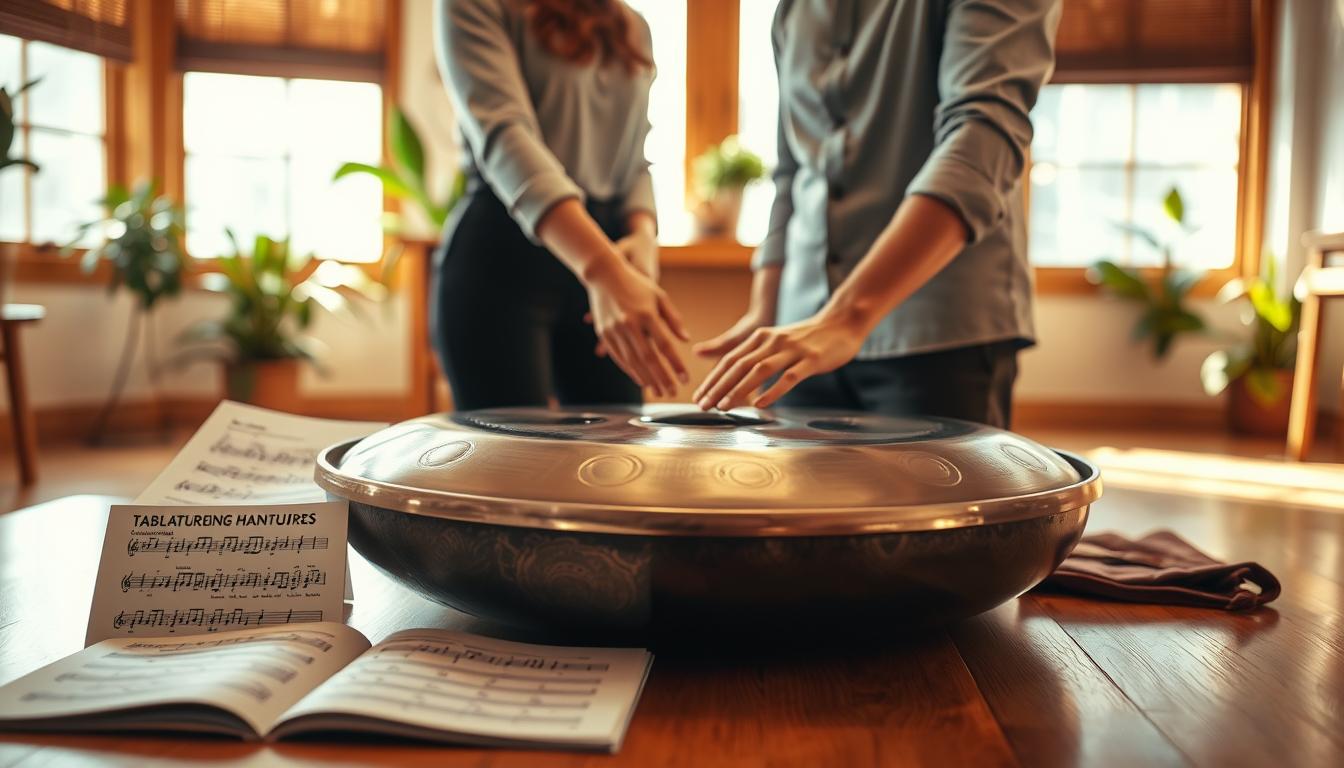

Getting started with this instrument often leads people to look for a quick way to play melodies without learning to read music. For many, visual notation is enough to learn where the notes are and begin playing the handpan.
What is tablature? It is a circular diagram showing the instrument from above and indicating where to strike. A simplified score, by contrast, uses numbers and rhythmic markers to organize the tempo.
For example, a beginner can follow the diagram to position their hands, then use a simplified score to practise note lengths. This guide has a clear aim: understand tablature, learn to read it, then add scores to improve rhythm and accuracy.
What this guide covers: why diagrams appeal to beginners, how diagrams compare with scores, how to read them step by step, using a metronome, exercises, and printable resources.
Rest assured: you do not need to read music at first, but you do need clear reference points for note positions, hand coordination, and tempo. Bear in mind that tablature often gives less precise information about note lengths; we will cover that limitation below.
Why handpan tablature appeals to beginners
For beginners, seeing the notes on the instrument makes the first steps easier. This visual approach suits the instrument’s circular shape: the note layout guides your hands and lets you produce satisfying sounds quickly.
A method that requires no music reading makes starting easier. Instead of deciphering symbols on a staff, you follow patterns and colors to learn to play. According to Sonodrum, most beginners prefer these visual aids.
Accounts from learners suggest that many make progress within a few weeks, although everyone’s path is different. Their experiences describe memorized patterns and faster transitions between the right and left hands thanks to visual cues.
How tablature helps visual and auditory memory
Associating an area of the instrument with its tone strengthens memory. You make a pattern automatic by connecting the movement with the sound. That is a real advantage when learning the handpan and staying motivated.
“The colored diagrams helped me play a repeating pattern after just a few sessions.”
In practice, start with what motivates you, then add simplified scores when you need rhythmic guidance.
Handpan tablature: a simple alternative to sheet music
A pattern can be learned very quickly by sight, but it may lose its character without timing cues.
Key differences: diagrams show where to strike the instrument and help you get started quickly. Numbered notation and scores explain when to play each note and how long to hold it. That distinction affects the musical result and your ability to reproduce a piece.
Practical benefits:
- Find notes immediately and make fewer placement mistakes.
- Make quick progress, play the handpan, and build confidence.
- Use an intuitive visual aid that helps beginners memorize a pattern.
Limitations to know about: tablature often omits note lengths, tempo, and subdivisions, which can lead to an approximate performance. The same sequence of notes can sound very different depending on the rhythm you choose.
“Without note-length cues, it is hard to share a piece faithfully.”
When should you move on to a score? Add a simplified score when you begin working with a metronome, want a steady pulse, or need to manage accents and dynamics. Combining the two works best: use the diagram to locate notes and the score to structure the piece.
read handpan sheet music and tablature
Understanding a handpan tablature diagram
Think of the diagram as a picture of your instrument viewed from above. Each circle or area represents an actual note on its surface. Place the instrument on your lap or a stand, then compare the drawing with the instrument itself.
Reading the top-down view of the instrument
Find the center first. The central circle is the Ding. Around it, the tone fields form a ring of notes.
Tip: point to each area on the diagram, then gently strike the same area on the instrument to connect the image with the sound.
Finding the Ding and tone fields for your scale
The Ding has a lower pitch and anchors the musical phrase. Check that the diagram matches your scale and the number of notes on your instrument. If it does not, adapt it or find a compatible version.
Color codes and right-hand / left-hand cues
Many diagrams use colors (for example, red = right hand, blue = left hand) or symbols to show when to alternate hands. These cues help with coordination and planning the next strike.
“Mark each area, strike it gently, and listen: the layout soon becomes familiar.”
read handpan sheet music and tablature
How to read handpan tablature step by step
First locate each area on the drawing precisely, then check its sound on your instrument. Identify the indicated note, find the matching tone field, and strike it very gently to confirm its pitch.
A simple process:
- Find the note on the diagram.
- Locate the tone field on the instrument and test it with gentle strikes.
- Play slowly in the indicated order.
- Repeat the pattern until you have memorized it.
To memorize the positions, start with very gentle strikes, then improve your accuracy. Look at the diagram when changing tone fields, then look back at the instrument as you play.
Look ahead by one or two strikes to make your movements smoother. Keep your movements small so you can continue without tension, and preserve resonance by avoiding resting your palms on the instrument.
To keep time, count 1‑2‑3‑4 aloud and practise cycles of 4 or 8 beats. Start with a metronome at 60 BPM; once you can play the pattern comfortably, gradually increase to 70–80 BPM.
“Practice routine: warm up (Ding + low note), play a two-bar D Kurd pattern, pause, then repeat for three minutes without mistakes.”
When you want to write down the rhythm, add simplified scores to show the beats and note lengths.
Simplified handpan scores: the ideal companion to tablature
Simplified scores complement visual playing by adding precise timing and clear reference points. They remain accessible because they do not require fluency in traditional music notation, while still showing note lengths and rhythm.
Reading and structure: read from left to right. Bars are numbered, while lines mark beats and subdivisions. This helps you place each strike at the right moment.
Tempo, BPM, and changes
Tempo is shown in BPM (for example, at 60 BPM each beat lasts about one second). At 80 BPM, the pulse feels livelier. Markings such as rall. or a new BPM value signal changes.
Numbers, hands, and symbols
Numbers represent notes (1 = the lowest note), and D = Ding. A central line separates the right hand (above) from the left hand (below) to help with coordination.
Common symbols: S/T (percussive strike), P (dampened note), K/F/d (knock/effect), – (ghost note), M (muted), underline = finger roll.
In practice, let a note ring until the next strike unless instructed otherwise, and adjust the dynamics to suit the music.
Essential striking techniques for playing cleanly from tablature
A short, relaxed movement produces a clearer note than a long, tense strike.
How to strike: let your fingertip or finger pad touch the center of the tone field, then release immediately so it can rebound. Contact should be brief and precise to preserve resonance.
Fingers, relaxation, and accuracy
Use the fingertip for a softer tone and the finger pad for a fuller sound. Keep your wrist relaxed and avoid large movements.
Controlling dynamics
To work on volume, play the same note ten times at a consistent intensity, then deliberately vary it from pp to ff. This helps you control your musical expression.
Common mistakes and corrections
- Leaving your hand on the surface muffles the note — lift it as soon as possible.
- Striking too hard or aiming between two tone fields — slow down and aim for the center.
- Stiff wrists — make smaller movements and breathe.
A note of caution: use fist strikes and knocks sparingly. This percussion instrument is sensitive; strike moderately to avoid damaging it.
| Movement | Target area | Quick correction |
|---|---|---|
| Brief contact | Center of the tone field | Shorten contact time |
| Finger pad | Middle of the tone field | Relax the wrist |
| Gentle knock | Chosen edge | Use less force |
“Slowing down and making smaller movements corrects most muffled notes.”
To broaden your points of reference and enrich your practice, occasionally compare the handpan with other instruments, such as a Tibetan singing bowl, and adapt your techniques.
Practical exercises for making quick progress with tablature and scores
Short, regular exercises make a real difference to coordination and rhythm.
Short routine (5–15 min): 3 parts — technique, rhythm, and application. Begin with a two-minute warm-up on the Ding with a metronome, then spend 5–10 minutes on a written pattern and two minutes on guided improvisation.
Left-hand / right-hand coordination
Short patterns: practise two-bar phrases. Alternate between right and left hands, then reverse their roles to balance your playing.
A steady pulse on the Ding
Strike the Ding on every beat (1‑2‑3‑4). Then add an offbeat strike to steady the tempo.
Subdivisions and control
Exercise in groups of two: play two strikes per beat. Then try groups of three: play three strikes per beat. Always count aloud and stay slow to avoid rushing.
Check your playing: if the sound becomes muffled, lower the tempo and make smaller striking movements. Record yourself once a week and listen back: Is the tempo steady? Are the notes clear? Are both hands balanced?
“Practise in short sessions and record yourself regularly so you can hear what needs work.”
For printable aids and exercise templates, see beginner scores that require no music reading. These resources help you write down patterns and track your progress.
| Goal | Duration | Exercise | Sign of progress |
|---|---|---|---|
| Hand coordination | 5–10 min | Two-bar pattern, then swap hands | Steady rhythm and balanced strikes |
| Steady tempo | 3–5 min | Ding on every beat, then add offbeats | Stability with the metronome |
| Subdivisions | 5 min | Groups of two, then three; count aloud | Clear notes without rushing |
| Evaluation | One recording a week | Listen critically and note improvements to make | Measurable improvement from week to week |
Useful resources for finding, printing, and creating tablature
A good starting point is to find PDFs and methods that match your tuning exactly. Look for score libraries, player groups, and specialist resources that offer downloadable files ready to print.
Check compatibility: confirm the scale (for example, D Kurd) and number of notes before downloading anything. If a document does not match your instrument, adapt the transcription or look for a suitable version.
Downloading and printing — a practical checklist
- Choose A4 paper and high contrast for easier reading.
- Laminate practice sheets and use erasable pens.
- Number and organize sheets by difficulty, tempo, and technical goal.
Notepan: write, listen, and export
Notepan lets you choose a tuning, place notes visually, listen to playback, and adjust the tempo in real time.
Export: generate a PDF or JPEG to print or share. This is useful for creating your own handpan scores and keeping templates suited to the number of notes on your instrument.
Recommended books and courses
Useful learning materials include:
- Instruments du Monde — 25 scores for D Kurd (9/10 notes) + 16 videos.
- Master the Handpan — a structured method for pieces and technique.
- Handpan Basics (David Charrier) — foundations and progressive exercises.
Tip: laminate your printed PDFs to protect the pages while you practise, and mark variations with an erasable pen.
Organize your files by difficulty and goal (coordination, dynamics, effects). For more resources and practical exercises, see how to read handpan sheet music and tablature.
Conclusion
In short, a visual aid helps you learn note positions quickly and hear results from your first session. Tablature helps you locate notes; a score provides rhythmic structure.
Progress in three steps: 1) memorize the note layout with a diagram, 2) practise with a metronome, 3) write down beats, note lengths, and dynamics in a suitable handpan score.
Always check the scale and number of notes before downloading a document to avoid frustration. To start now, choose a short pattern, practise it slowly for 10 minutes, then write it down so you can play it again tomorrow.
Consistency and method: short daily sessions are more effective than irregular practice. By combining these techniques, you build knowledge, technique, and musical skills you can use elsewhere without depending on traditional music notation.