
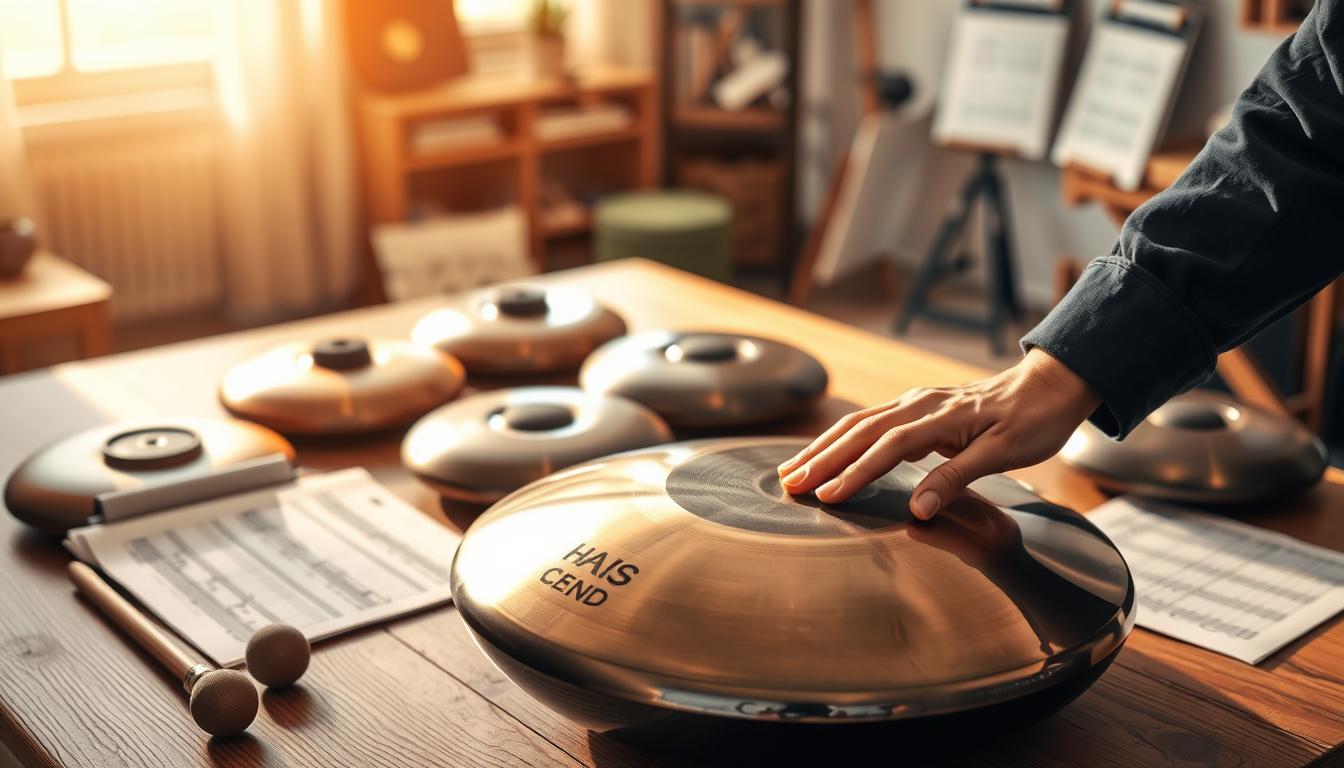

Searching for an instrument on a marketplace can seem convenient: fast delivery, competitive prices and a wide selection.
Yet buying online has its pitfalls. Very low prices increase the risk of tuning defects and poor finishes.
This guide aims to help you decide whether to buy and, above all, what to check before paying.
Here we explain what reviews cover: feedback on sound quality, tuning and service, as well as the limits of marketplace ratings.
You will find practical advice: checklists, remote tests, warning signs and safer alternatives in France.
To better understand provenance and care, see this specialist resource on manufacturing and resale: information about the instrument.
Why buying a handpan on Amazon appeals to so many people in France
Immediate availability is the main attraction of buying online. In France, some makers have waiting times of several months. Marketplaces shorten that wait and allow buyers to decide sooner.
Instant comparison: buyers can see several models and their price differences on the same day. This visibility often encourages a quick decision.
What the platform does well
Shipping and tracking: organized delivery, real-time tracking and simpler returns. The standardized buying experience can feel reassuring compared with classified ads or direct sales.
What it does not guarantee
The choice of maker, tuning checks and material traceability still depend on the seller. Online sales have risen by 30% since 2022, but a marketplace does not certify structural quality.
Key point
In this market, an instrument’s real value depends on its maker and seller, not the platform. Some offers look unbeatable but may conceal compromises in materials, finish or tuning.
Understanding handpan prices and spotting deals that are too good to be true
The listed price does not always reflect how an instrument was made or its quality. Before buying, read the listing carefully and know what to check.
Price ranges in 2026: a quality 9-note model generally costs between €1,200 and €2,500. A 7-note model is more likely to cost between €990 and €1,500. More notes mean greater complexity and an expectation of better stability.
Warning threshold and supporting evidence
Below €1,200, be cautious: fragile materials, uneven finishes and tuning defects are more common. Low prices often indicate that each note has not been checked individually.
| Type | 2026 price range | Key points |
|---|---|---|
| 7 notes | €990 – €1,500 | Simple; less stable than a 9-note model |
| 9 notes | €1,200 – €2,500 | Stable tuning, consistent harmonics |
| Entry level | < €1,200 | Lower-quality finish and steel |
| Cost factors | — | Around 80 hours of work, steel accounting for about 40% of the cost, manual tuning |
The reasons for the price are straightforward: shaping, treating the steel and tuning by hand take time. Manufacturing can take around 80 hours, accounting for a substantial share of the cost.
On a marketplace, consider less visible costs: shipping, customs duties and complicated after-sales service if the seller is outside the EU. To spot a deal that is too good to be true, watch for a very low price combined with a vague listing, no audio or video evidence and an unclear origin.
Buying rule: budget for retuning or a professional inspection if you buy remotely.
Handpans on Amazon: reviews, risks and what to check
Buying through a large marketplace does not guarantee thorough quality control.
Sold by a third party may mean the platform ships the instrument even though it was made and checked elsewhere. That distinction matters for tuning and traceability.
Risk profiles and warning signs
You may encounter opportunistic sellers, resellers without expertise and brands with no real presence. Duplicated listings and generic photos are common.
Uncertain origin and quality control
A significant proportion of listings come from uncertified factories. Tuning may be uneven, and the material composition may be unknown.
Confusing terminology
Online listings often confuse a handpan with a steel tongue drum or a “hang drum.” Check the wording, detailed photos and branding.
Complaint figures
General marketplaces show a higher complaint rate, for example 27%, compared with 6% for specialist sites. This signal deserves attention.
| Case | Signal | Risk |
|---|---|---|
| New seller | Incomplete profile, few reviews | Limited after-sales service |
| Generic photos | Reused images, vague wording | Product differs from the listing |
| Very low price | Vague listing, no audio evidence | Scams or low-end instruments |
Good practice: ask for proof of authenticity and a personalized video, then assess the seller carefully. To compare safer offers, also explore specialist options for a low-cost handpan.
Amazon sellers: how to assess reliability before buying
Before buying, check the seller quickly. In 60 seconds, look at how long the profile has existed, its sales volume and the consistency of its product listings.
Warning signs
Be wary of a recent profile, vague technical information or a seller who pressures you to pay quickly.
A refusal to provide a personalized video, requests to pay outside the platform and descriptions that omit the material are also warning signs.
Reading reviews
Look out for reviews that are too short, repetitive or focused only on delivery. Seek feedback on sound quality and tuning.
Essential questions
- What are the exact model and scale?
- How many notes are there? What is the steel composition? Is it nitrided?
- What are the after-sales terms and warranty period? Who pays for returns?
Get everything in writing
Ask for an invoice, a warranty and a written returns policy. If the seller refuses, the risk of a bad transaction increases.
Tip: compare several sources, including specialist forums and information about the seller outside the marketplace, to assess reliability and avoid unpleasant surprises. To compare offers, also consider options for a low-cost handpan.
Authenticity: avoiding counterfeits, stolen photos and copied listings
Many listings use borrowed photos to appear professional. This practice, called catfishing, often conceals a product that does not exist or differs from the one shown.
Ask for a personalized video
A simple procedure: ask for a video in which the seller plays every note, shows the instrument’s rim and holds a sheet of paper bearing the date and a word you choose. This evidence greatly reduces the risk of a scam.
Reverse image search
Copy the image and run a reverse search with Google Images. If the photo appears on several sites, the listing may have been copied.
Serial number, certificate and proof of purchase
Ask for the serial number, a maker’s certificate and an invoice. Also request the main details of the instrument’s history: year of manufacture, maintenance and repairs. These details help build confidence.
What to do if there is no serial number
If there is no serial number, ask for an invoice or direct contact with the maker. Without proof of origin, decline the purchase: the risk of a counterfeit or improper resale remains high.
Contact the maker
Contact the maker to confirm the model and verify the resale. Their expertise can identify suspicious cases and help you avoid unpleasant surprises.
Practical rule: without a personalized video or proof of origin, the purchase is high risk even if the price seems attractive.
Sound quality and tuning: essential tests, even from a distance
Pitch accuracy and sustain determine an instrument’s real value. They are the top priority: an attractive appearance cannot make up for poor sound quality or bad tuning.
Test every note with a tuner
Request a good-quality recording of each note played separately. Use a tuning app to compare the claimed pitch accuracy with what you hear.
Ask for another check after 24 hours: stability can change with temperature or transport.
Defects that can go unnoticed
Listen for inconsistent harmonics, sustain that is too short or a “muddy” resonance.
These defects reduce long-term sound quality and are often hard to detect in short videos.
Budget and professional help
Set aside €150 to €400 for retuning, depending on the workshop. Include this expense in your decision.
If you have doubts or are buying remotely, ask a musician or technician for a quick assessment: their expertise may save you a much larger expense.
“A brief professional check can protect your musical experience for years to come.”
To learn more about provenance and care, see these specialist resources.
Inspecting the condition: steel, rust, dents and critical areas
An external inspection often reveals defects that affect the sound far more than the appearance. Physical condition directly affects sound quality and tuning stability, as well as appearance.
Areas to inspect
Check these specific points because they affect how well the instrument holds up over time:
- Ding, or dents: deformation of a note can throw its harmonics out of tune.
- Central dome: any deformation changes how the other notes respond.
- Surface: deep scratches or chips that penetrate the protective finish.
- Seams: cracked joins or separation near the edges.
- Hairline cracks: subtle but concerning signs for durability.
Oxidation and storage
Moisture encourages oxidation: rust attacks the steel, changes the tone and shortens the instrument’s life. An instrument stored poorly can deteriorate quickly.
For a remote purchase, ask for:
- High-resolution photos taken in raking light and showing every detail.
- A slow video showing a complete view around the instrument, with close-ups of the seams.
“Document the condition before paying: dated photos are useful if you need to return the instrument or make a warranty claim.”
Buying decision: minor surface marks may be acceptable; walk away if there is advanced corrosion, dents on the central dome or cracks near the seams. Keep all the evidence in case you need to make a claim.
New, used and “refurbished”: which should you choose online?
Choosing between new, used and refurbished strongly affects both your budget and the security of your purchase.
New and used prices: typical savings and risk levels
Typical savings: 70% of buyers save between 30% and 50% by choosing a used instrument.
Price guide: new instruments often cost between €1,800 and €3,500; used ones generally cost between €700 and €2,000, depending on condition and brand.
Risk rises when the history is unclear. Without proof of maintenance, retuning or repairs may cost between €150 and €400.
Used instruments on marketplaces: extra precautions and evidence to request
On general-interest sites, ask for specific evidence:
- high-resolution photos and a personalized video showing every note;
- the original invoice or proof of purchase;
- a detailed description of the instrument’s condition and any work carried out.
Approach: favor collection in person or, if shipping is necessary, a protected payment method and shipping insurance.
Where used instruments are often safer: communities, forums and specialist shops
Recommended channels: dedicated forums, specialist sales groups and shops that accept trade-ins.
These places often provide better insight into the seller and inspire greater confidence. Listings are often checked by enthusiasts.
“A used instrument can be an excellent choice, but only if its history can be traced to a standard suited to such a sensitive instrument.”
Brands, makers and models: pointers to help you avoid surprises
Choosing a recognized brand greatly reduces the risk of buying a poorly tuned instrument.
Established makers and the importance of reputation
A good reputation often indicates stable tuning, consistent production and quality after-sales service. Names mentioned in guides, such as PANArt Hang, Halo Handpan and Spacedrum, provide useful reference points, but verifiable provenance matters more than the name in a listing.
Signs of a well-made instrument
- Even finish and clean seams.
- No deformation of the central dome or notes.
- A certificate or serial number that makes the instrument’s manufacture traceable.
- Consistent sound across notes and stable tuning after testing.
Choosing a scale and model for your level
Beginner: favor simplicity and stability with a versatile 7- to 9-note model.
Intermediate player: choose more notes and a wider dynamic range for complex pieces.
Tip: if the seller cannot state the precise model, scale and number of notes, that is a clear warning sign. A good, traceable 7- to 9-note model is preferable to a larger, questionable instrument with unstable tuning.
“Prioritize traceability: it protects both quality and resale value.”
Conclusion
Finally, treat every listing as a case to verify before deciding.
Buy only if three criteria are confirmed: a realistic price, proven authenticity and sound quality checked by video or with a tuner. Below €1,200, any saving may disappear if retuning costs €150 to €400 or a return is impossible.
Before paying, ask for the seller’s identity, a written returns policy, high-resolution photos, a personalized video and the serial number. If anything is missing, pass on the offer and look for specialist alternatives.
To compare offers and find out where to buy an affordable instrument online, see this dedicated resource: where to buy an affordable instrument online.
Final tip: take your time, ask the right questions and favor a trustworthy purchase over an impulse buy.