
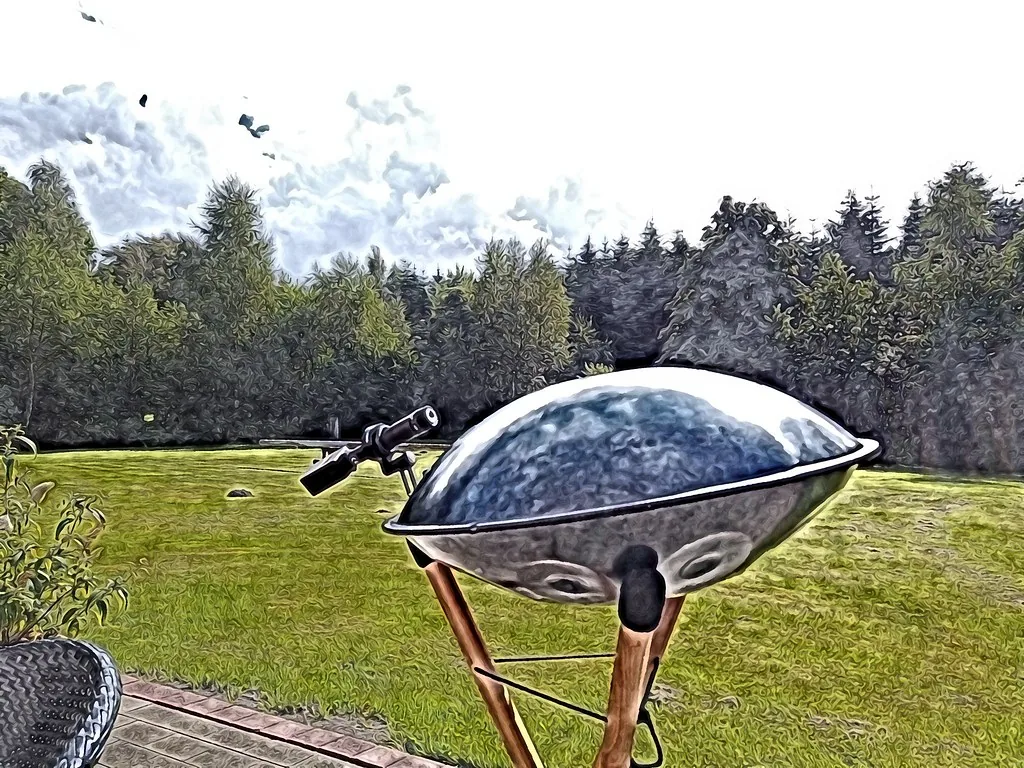

Quick introduction: tuning a metal instrument requires a careful method. A mistake can leave marks and permanently change a note’s pitch.
This practical guide explains how to recognize an instrument that is out of tune, what to check, and, above all, what to avoid before making any adjustment. The goal is to preserve sound quality and the balance between the fundamental and its harmonics.
In France, the safest solution is often to have a professional retune the instrument. The work requires suitable tools, precision, and experience; timescales and quotes vary with the work involved.
In the following sections, you’ll learn why the instrument goes out of tune over time, with tuning typically remaining stable for 2 to 5 years depending on use; what tuning actually involves; how to diagnose a problem; and what you can do safely.
A word of caution: if you suspect the instrument is out of tune, don’t rush to adjust it. For more information, see our detailed guide: how to tune a handpan.
Why a handpan goes out of tune over time
Repeated strikes and weather conditions gradually affect the instrument’s stability. A note’s pitch depends on the tension of its tone field: even a tiny change in that tension changes its frequency.
Gradual deformation: the metal, often 1 to 1.2 mm thick, changes under thousands of strikes. Even normal playing can shift a note without leaving a visible mark.
Playing habits and impacts that pose a risk
Striking too hard, using sticks, or practising “ding-bending” puts considerable stress on the steel. Many players seek more volume and unintentionally put their instrument out of tune.
A fall or impact can deform the instrument as a whole. Several frequencies may then become inconsistent, making adjustment more difficult.
Temperature, sunlight, and how long tuning remains stable
Heat causes the metal to expand and then contract; it does not always return to exactly the same shape. Playing while the instrument is under thermal stress increases the risk of instability.
- Typical tuning stability: 2 to 5 years, depending on quality and use.
- With inexpensive instruments, notes may shift within weeks or months.
To reduce the need for retuning, moderate the force of your playing, protect the instrument in transit, and avoid prolonged exposure to sunlight. For practical advice, see our tuning guide.
Tuning a handpan: what to know before adjusting the notes
Understanding the structure helps prevent mistakes. The concave shell holds the central ding and the tone fields arranged around it.
Each field acts as a membrane; the tension of the steel determines its frequency. Changing its curvature changes the note’s pitch.

What is actually adjusted
Tuning involves more than the fundamental. The goal is an accurately pitched note with a balance between the fundamental and its harmonics, often the octave and the fifth.
Why the work requires precision
- The process involves making minute changes to the metal’s shape, rather than tightening a string.
- Tools such as a digital tuner or rubber mallet help with measuring and testing, but they cannot replace experience.
- Hammering too hard or in the wrong place can make a note unstable, sometimes irreversibly.
Changing the scale: myth or reality?
Changing the original scale across several tone fields is rarely realistic. It often costs more than a new instrument.
Practical advice: identify the problem and measure each note before any adjustment. To explore the subject further, see our page on handpan tuning.
How to tell whether your handpan is out of tune
Identifying a tuning problem starts with careful listening and a repeatable method. Work in the same quiet room and strike each field with the same force. Measure each note to avoid false positives.
Listening or using an electronic tuner
Your ear can quickly detect a problem: beating, a note that seems to “waver,” or a muddy tone. An electronic tuner lets you check each note’s pitch more precisely.
Identifying each note
Find the scale diagram supplied by the seller. Identify each field and its note before you start checking. This makes it easier to track the results and communicate with a professional.
Frequency, 440 Hz, and 432 Hz
Check the tuner’s reference pitch: it is often set to 440 Hz. If your instrument is tuned to a 432 Hz reference, change the setting before measuring so that the readings make sense.
Cents and hertz: interpreting pitch
Results are expressed in cents or hertz. A practical threshold: a tolerance of about 10 cents. Beyond that, the difference becomes audible and may justify professional attention.
Smartphone apps and spectrum analysis
Apps provide a quick check, but a phone microphone is less precise. Avoid wind, place the phone close enough without overloading its microphone, and repeat the measurement for each note.
For a complete method and advice before making any adjustment, see our tuning guide.
What should you do if your handpan is out of tune without making the problem worse?
Before attempting a rushed adjustment, protect the instrument and prepare clear information for a professional.
First step: stop playing once you have confirmed that a note is out of tune. Put the instrument in its case to limit further stress, and keep it out of the sun.

Finding a professional and knowing what to send
Choose someone with specific handpan experience who understands your type of metal, whether stainless or nitrided steel, and can show examples from before and after their work.
Send a steady video playing one note at a time, followed by a few freely played passages. State the reference pitch, 440 or 432 Hz, and explain what happened, such as a fall, heat exposure, or transport.
Timescales, complexity, and assessment
Retuning can take from a few days to several weeks. It takes longer if the shells must be separated after an impact.
The professional will assess the measured pitch as well as the balance and stability of the notes, looking beyond their values in hertz alone.
Indicative prices in France and a precaution checklist
A common range is €100 to €300, depending on how many notes are affected, whether the instrument must be opened, and the transport arrangements. Some services charge €100 to €200 for minor pitch drift.
- Do not hammer or bend the instrument yourself.
- Document the problem with photos and videos.
- Keep the instrument out of the sun while you wait.
- Contact a professional promptly for an accurate diagnosis.
For a complete explanation of the process and how to send your instrument, see our guide to tuning and retuning.
Conclusion
To protect sound quality, take preventive measures rather than making hasty adjustments.
Yes, a handpan can go out of tune over time. The main causes are repeated strikes, impacts, temperature changes, and exposure to sunlight.
The safest approach is to listen, measure, and document the problem. If the pitch difference interferes with your playing or exceeds the tolerance, ask a professional to retune the instrument.
As a practical guide, a good quality instrument often stays in tune for several years. Retuning generally costs a few hundred euros, depending on the work required.
Simple care helps: play with a controlled touch, protect the instrument in transit, and store it away from heat. If in doubt, take a short series of measurements, record a clear video, and seek advice by consulting our learning guide.