
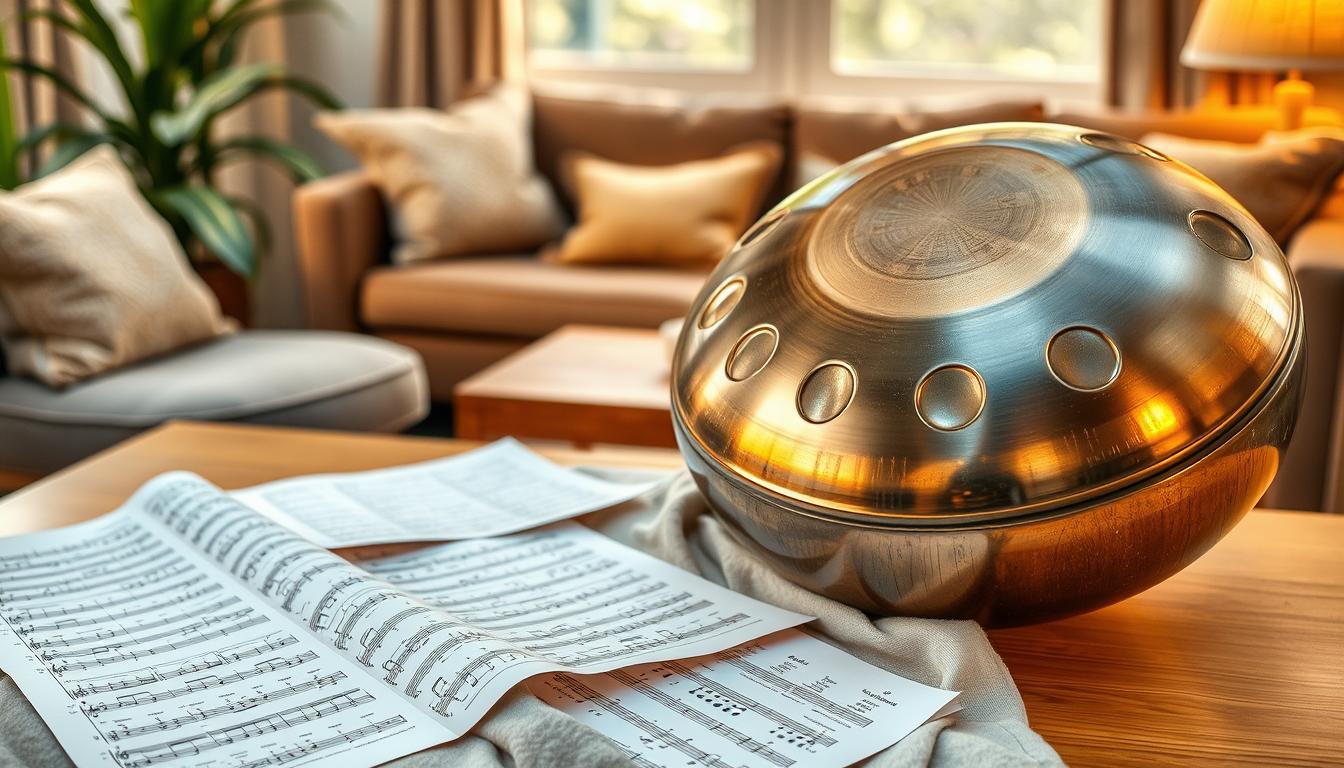

Goal: find free resources so you can start playing quickly. This guide is for beginners who cannot read music, casual players, and musicians who want to give their practice more structure.
What this guide offers: I’ll show you where to find PDFs, tutorials, and communities, then how to check the scale, number of notes, and difficulty level before you begin.
The handpan is an intuitive instrument. Its harmonic layout lets you play in tune quickly. That reassures beginners and makes learning easier.
The recommended approach: start with visual aids, then move on to simplified sheet music to work on rhythm, accuracy, and the structure of a piece.
Watch out for these pitfalls: downloading a file that does not match your instrument’s tuning or confusing the playing areas. Organize your files (PDFs, printouts, and notes) to make faster progress.
To go further, read this practical tutorial on reading tablature and sheet music: read handpan tablature. Notepan is mentioned as a useful tool for creating, adapting, and exporting your own versions.
Understand what you are downloading: sheet music, tablature, and methods that do not require reading music
The instrument’s shape itself makes it easier for beginners to take their first steps in music. Before downloading a file, learn to distinguish between the different types of resources.
Tablature: diagrams viewed from above that show where the notes are. These visual guides are ideal for getting started quickly and coordinating your hands.
Modern handpan sheet music: it shows note lengths, rhythm, symbols (open strikes, muted strikes, and rests), and tempo. It helps you play accurately and consistently.
A method that does not require reading music uses patterns: playing areas, colors, or numbers. You follow visual cues instead of traditional staff notation while still keeping track of the beat.
Practical rule: if your goal is to learn to play quickly, start with tablature. If you want steadier sound and tempo, move on to simplified sheet music.
To talk with other players and get files they have tested, visit an active forum such as the Symphozik community.
Why visual sheet music appeals to so many beginners
Reading a diagram viewed from above turns learning into a natural movement.
Visual and auditory memory: the position of a note on the instrument becomes a visual cue. Its sound strengthens your memory. This association speeds up learning much more than studying traditional music notation.
Visual and auditory memory: a more direct approach
According to Sonodrum, 90% of beginners prefer a visual method that lets them start without getting stuck on theory.
Color codes and diagrams viewed from above
The diagram shows the area to strike as you see it on your instrument. You can quickly identify the right hand (red) and left hand (blue).
Practical tip: keep the same pattern shape at different tempos. Work slowly at first, then increase your speed.
To find tested tablature, consult a songbook and online resources such as sheet music and guides, or a page of recorder sheet music suited to teaching: teaching resources.
| Benefit | Visual method | Traditional music notation |
|---|---|---|
| Learning speed | Fast | Slower |
| Hand coordination | Made easier by color codes | Requires more abstract reading |
| Motivation | Audible results from the first sessions | Progress becomes apparent later |
| Transfer | Easy from one tempo to another | Requires practice |
Free handpan sheet music: where to find it and how to use it
A good PDF can turn an uncertain practice session into a structured one.
Where to focus your search: start with PDF libraries and songbooks published by brands. Specialist sites often publish files tested on a real instrument and accompanied by a key to the symbols.
Libraries and songbooks
Download songbooks that specify the tempo, symbols, and scale. Sonodrum offers a PDF pack with an explanatory chart after email registration.
Tutorials and online lessons
Many courses provide adapted sheet music and videos showing how to strike the instrument. Look for packs that pair a melody with a tutorial to save time.
Player communities
Ask on forums whether there is a D Kurd version or one compatible with a nine-note instrument. Feedback from other players reduces tuning mistakes.
Good practices before downloading
- Check the scale, number of notes, and stated difficulty level.
- Choose PDFs that include a key to the symbols and a tempo indication.
- If your instrument lacks a note, replace it with a nearby note or look for another version.
| Source | Format | Key included | Compatibility |
|---|---|---|---|
| Sonodrum (songbook) | Yes (symbol chart) | D Kurd, common configurations | |
| Specialist sites | PDF / ZIP | Often | 9, 10, or 11 notes |
| Online lessons | PDF + video | Yes | Version depends on the scale |
| Forums and groups | Shared PDF | Varies | Tested by players |
Before playing pieces, read the symbol key, identify the patterns, and practice with short loops. To learn more about reading them, see our guide to reading handpan tablature.
Download and organize your PDF sheet music for effective practice
Keeping your PDFs in order makes every session easier. One main folder called Handpan sheet music is enough. Inside it, create subfolders by scale, then by difficulty level. You will be able to find a piece in under ten seconds.
Printing, laminating, and annotating
Print your sheet music so you can keep it in view while playing. It will be easier to read, and you will not have to keep switching back to your phone.
For a durable practice sheet: print it, laminate it, then write on it with an erasable marker. Note fingerings, which hand to use, accents, and rhythmic corrections.
Sorting by tempo, level, and technique
Sort your sheet music by tempo (slow, medium, or fast) to build measurable progress with a metronome. Also separate it by technique: open strikes, muted strikes, and alternation between the right and left hands.
Before each session, write down the date, a tempo you can play comfortably, and your goal (accuracy, dynamics, or consistency).
| Criterion | Method | Benefit |
|---|---|---|
| Organization | Folder by scale, then by level | Quick access |
| Durable practice sheet | Print, laminate, and use a marker | Reusable annotations |
| Sorting | Tempo and techniques | Focused progress |
Read handpan tablature step by step
Start by reading the tablature like a map: each drawing viewed from above shows an area corresponding to a real note and its place in the piece.
Decode common symbols
Here is a short, practical key to help you play quickly and accurately:
- ● = open strike (clear sound)
- ○ = muted strike (duller sound)
- No symbol = rests (pauses)
Understand the timeline
Tablature is usually presented in sequences. Read it from left to right: each diagram corresponds to a beat or a moment in the piece.
- Find the central note.
- Play only beats 1 and 3.
- Add beats 2 and 4.
- Finish by adding muted strikes and accents.
Identify the hands and correct mistakes
Colors (often red for the right hand and blue for the left) help you make alternating hands automatic.
- Common mistakes: striking the right area at the wrong time, mixing up the colors, or speeding up without control.
- Quick corrections: count aloud, lower the tempo, repeat a two-beat loop, and check that your hand returns above the correct area.
Next step: once you are comfortable with the tablature, move on to simplified sheet music to strengthen your rhythm, note lengths, and accuracy.
Read simplified sheet music to improve rhythm and accuracy
Simplified sheet music provides clear rhythmic cues without overwhelming you with music theory. It shows note lengths, rests, and accents. It remains visual and practical for learning.
Rhythm and duration: counting beats
Count “1, 2, 3, 4” to connect each note with a precise duration. Read the rhythm line without playing first.
Clap on every beat until you can feel the structure. Then add the handpan notes once you know the pattern.
Practicing with a metronome
Set the metronome between 60 and 80 BPM to improve accuracy. Work in short loops, one phrase at a time.
- Read the rhythm without playing.
- Clap in time.
- Play slowly while following the sheet music.
- Increase the tempo in steps once you can play accurately.
Useful rule: if your accuracy drops, lower the tempo by 5 to 10 BPM instead of pushing on. This preserves your technique and builds consistency.
To adapt sheet music to your instrument or create your own versions, use a dedicated tool such as Notepan and related guides. It makes it easier to set the scale and tempo and to create files ready to print.
Use Notepan to create, adapt, and export your handpan sheet music
Notepan turns a melodic idea into a clear sheet in just a few clicks. This free tool lets you adjust your instrument’s configuration before writing.
When to use it: when sheet music found online does not match your scale, or when you want to write your own melodies in an easy-to-read format.
Set up your instrument
Choose the scale, tuning, and number of notes so you do not write notes your instrument cannot play. This simple step prevents transcription errors.
Listen and adjust in real time
Instant playback lets you check a phrase before playing it. Set the tempo, note lengths, and strike intensity to anticipate the piece’s dynamics.
Export and organize your repertoire
Export as a PDF or JPEG to print, share, or archive your pieces. Keep a “draft” version and a final “clean” version.
Practical example: adapt a tutorial by replacing one or two notes your instrument lacks with nearby notes. Listen, make corrections, then try it on your instrument. For more handpan resources and sheet music, see this practical guide: find sheet music without reading music.

Turn sheet music into real progress: an exercise routine and playing techniques
Turning a PDF into effective practice takes a simple method. Here is a weekly routine designed to turn each sheet into concrete goals. Practice three times a week: 20 minutes of coordination, 15 minutes of accuracy, 10 minutes of rhythm, then 5 minutes of listening.
Left- and right-hand coordination
Start by alternating hands evenly on two notes. Play slowly, count every beat, and follow the metronome.
Then expand the exercise: play patterns of three or four notes in sequence and add accents. This strengthens coordination and prepares your hands for longer pieces.
Striking accuracy
Aim for the correct area on every note. Control the height of your hand, let it bounce back naturally, and avoid pressing your palm onto the instrument.
Tip: use your fingertips for a clearer sound. Mark problem areas on the sheet music and repeat them in short loops.
Rhythm and tempo
Develop a steady beat, then move to two beats without losing your sense of time. Keep the metronome at the same reference tempo throughout.
Increase the tempo in steps of 5 BPM only when you can stay consistent over several repetitions.
Learn in short loops and record yourself
Isolate one or two measures, slow down, repeat, then gradually speed up. Alternate a technical exercise with a melody you enjoy to avoid frustration.
Record yourself to assess note accuracy, tempo stability, and sound quality. Annotating the sheet music after listening makes your progress visible.
| Goal | Duration | What to measure |
|---|---|---|
| Coordination | 20 min | Alternating hands, then playing sequences |
| Accuracy | 15 min | Playing areas, bounce, fingertips |
| Rhythm | 10 min | Metronome, 5 BPM steps |
Two-week action plan: choose a piece, set a starting tempo, track your progress, and note three things to improve after each recording. For more teaching resources, also see sheet music adapted for beginners.
Conclusion
A few simple steps can turn sheet music into real progress.
In summary: first identify the type of resource (tablature or sheet music), check the scale and number of notes, then organize your files before practicing.
How they work together: tablature helps you get started quickly; simplified sheet music helps stabilize rhythm and structure. Combine both to build your repertoire.
Three pillars of progress: a metronome (60 to 80 BPM), short loops, and recordings to measure your development.
Try this: choose a suitable piece, practice it between 60 and 80 BPM, annotate the page, then raise the tempo when your playing becomes consistent.
Final tip: adapt your melodies with Notepan, listen to them before playing, and export them as PDFs to share. For tested songbooks, see the pack offered by Sonodrum.
Remember: this instrument is a means of expression. Learning resources should guide your creativity without restricting it. Practice for a few minutes each day to make quick progress.