
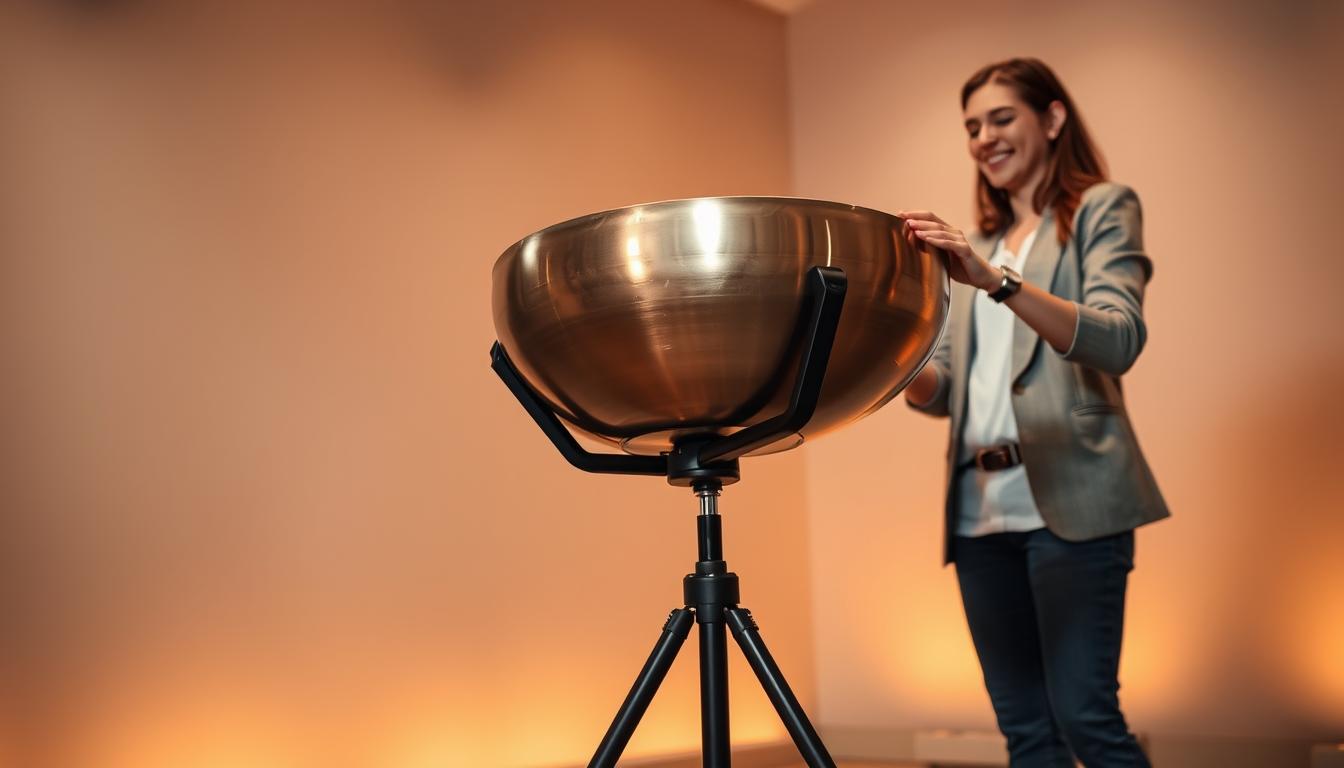

A handpan often costs between €500 and €700. This buying guide explains how to choose a reliable stand so you can play better and protect this fragile instrument.
Support is only part of the equation. Ergonomics matter too: set the right height and angle to preserve sound quality.
Needs vary between the studio, home, stage and outdoors. Each setting calls for different equipment criteria.
What you will find below: types of stands, materials, safety, transport, accessories, budget and brands. You will also get a checklist with figures to help you buy with confidence.
Given the instrument’s price and fragility, the next section explains why you should invest in a suitable stand.
Why invest in a stand for a delicate handpan worth €500–€700?
Protecting a fragile instrument starts with giving it suitable support. A well-designed accessory prevents slipping and reduces worry before and during practice.
In practical terms, a good stand improves everyday playing: the instrument stays in place, movements feel safer and the playing experience becomes smoother.
- Common risks: falls, knocks and minor scratches during simple handling.
- Acoustic impact: inadequate support can affect vibrations and tuning by up to 5%.
- Protection offstage: 80% of damage occurs during storage or transport.
Financially, it makes sense to protect a €500–€700 instrument with a suitable accessory. It is a small expense that helps preserve sound quality and longevity.
Compare options according to your priorities
Choose a different solution depending on whether safety, portability or sound projection matters most to you. To explore tested options, look at handpan stands.
| Need | Benefit | Key criterion |
|---|---|---|
| Safety | Maximum protection against falls | Minimal contact with the shell |
| Portability | Quick setup and low weight | Foldable, lightweight design |
| Sound projection | Better transmission of vibrations | Low-absorption materials |
Handpan stands and tripods: stability, height and playing comfort
Your choice of stand affects precision, comfort and sound projection during playing sessions.
What musicians look for: safety, ergonomics, sound quality and ease of transport
Safety: reduce the risk of tipping and protect the shell. Musicians want a secure hold without slipping.
Ergonomics: set the right height and angle to avoid strain. Easy adjustment helps you switch between sitting and standing.
Sound quality: limit contact with the surface and position materials carefully to preserve resonance.
Transport: weight and how the stand folds affect its usefulness for travel and concerts.
Differences between a stand, stool, tripod and dedicated support
- General-purpose stool: often affordable, but it has a large contact area and may cause unwanted vibrations.
- Adjustable tripod: versatile for sitting or standing, practical outdoors and easy to move.
- Dedicated stand: designed to minimize contact and maximize acoustic clarity.
“Choose minimal contact and suitable materials so the notes can ring freely.”
| Setting | Main benefit | Key criterion |
|---|---|---|
| Home / studio | Comfort over long sessions | Precise height adjustment |
| Stage | Stability under demanding conditions | Non-slip feet |
| Travel / outdoors | Compact size | Weight and folding design |
First decide whether your priority is stability, portability or a balance of both. For tested options and complementary accessories, explore handpan accessories.
Main types of handpan stands and how to use them
Each type meets a specific need. Here is a quick overview to help you choose for the way you play.
Adjustable tripods
Typical use: outdoors or sessions that alternate between sitting and standing.
Benefit: you can change position without taking everything apart. Ideal if you alternate between concerts and rehearsals.
Choose these models if you frequently perform at different venues.
Floor stands
Typical use: long rehearsals and stage performances.
Benefit: a low center of gravity provides greater stability. Ideal when safety comes first.
For the stage and studio, choose a heavy, sturdy structure.
Lap or thigh supports
Typical use: playing on the move, street performances and quick setup.
Benefit: instant setup and excellent portability. Limitation: less suitable for long sessions.
Wall mounts
Typical use: decoration, storage and display.
Benefit: they save space and display your percussion instrument at home.
Foldable travel stands
Typical use: transport, touring and storage in a bag.
Benefit: lightweight and foldable, they open in seconds. Choose one if you travel often.
If you perform concerts, choose a sturdy model; if you travel, prioritize a compact one.
Handpan tripod: when to choose one and what to check
For outdoor playing or quick changes in posture, a tripod is often the best option.
Weight and portability
An aluminum model weighing around 2.5 kg offers a good balance between stability and ease of transport.
Use this figure to decide whether portability or sturdiness matters more to you.
Height adjustments
Choose models with several positions so you can switch easily between sitting and standing.
Check that the clamps move smoothly and that the adjustment range is sufficient.
- Secure locks and a system that prevents twisting.
- Stable tripod legs and good-quality foot pads.
- Enough clearance beneath the shell for your movements and legs.
- Protected contact areas to preserve sound quality.
| Criterion | Why it matters | Guide |
|---|---|---|
| Weight | Portability on tour | About 2.5 kg (aluminum) |
| Locking mechanism | Safety during energetic playing | Secure hold without looseness |
| Foot pads | Grip onstage | Reinforced rubber |
| Compatibility | Player comfort | Legroom and access to the shell |
Before any purchase, test how the stand performs in real conditions. Choose products designed for a delicate instrument and play safely.
Floor stands: the “maximum stability” option for safe playing
For sessions where stability is paramount, a floor stand offers exceptional steadiness.
Load capacity: look for a reliable structure. Models such as the Katanui Floorstand claim a capacity of up to 15 kg. This provides reassurance: a safety margin helps prevent deformation and protects your instrument.
Non-slip feet and grip quality
Rubber tips improve grip on wood floors, tiles and stages. They also reduce the small movements that cause unwanted noise.
- Consider a floor stand when you want maximum stability at home, in the studio or onstage.
- Quick checks: test for tipping and slipping, and inspect the contact areas.
- Onstage, a repeatable setup steadies your posture and limits unwanted sound.
Why it makes a difference: a stable base builds the player’s confidence and greatly reduces the risk of falls. For complementary accessories and practical advice, see these essential accessories.
Materials: beech wood, metal, rubber… Effects on vibrations, durability and appearance
Your choice of materials affects both the sound and the lifespan of your setup.
Beech wood
Beech wood has a high density (about 720 kg/m³). This helps absorb shocks and limit unwanted vibrations.
Benefits: a warm appearance, a premium feel and protection against minor scratches.
Anodized metal
Metal is highly robust. However, anodized metal can transmit resonance and may corrode in damp conditions.
Tip: choose corrosion-resistant finishes to preserve the steel’s sound quality.
Rubber and finishes
Rubber absorbs shocks effectively and protects the shell. However, it wears out sooner in areas subject to heavy use.
Pay attention to the finishing touches: soft contact areas, no sharp edges and scratch-resistant coatings help prevent abrasion during frequent handling.
| Material | Effect on vibrations | Durability | Appearance |
|---|---|---|---|
| Beech wood | Good absorption | High if varnished | Warm |
| Anodized metal | May transmit vibrations | Very high (if kept dry) | Industrial |
| Rubber | Absorbs vibrations at contact points | Moderate (subject to wear) | Subtle |
Height, angle and ergonomics: find the ideal position for comfortable playing
Good posture improves accuracy and lets you play longer without pain.
Guidelines based on your height
Try these simple measurements with your equipment:
| Your height | Stand height (cm) | Note |
|---|---|---|
| < 1.65 m | 45–50 | Keep your forearms relaxed |
| 1.65–1.80 m | 55–65 | Keep your shoulders in a neutral position |
| > 1.80 m | 70 or more | Avoid bending your torso |
Sitting or standing
For seated playing, aim for 45–55 cm. For standing, 65–75 cm is a useful range.
Test each setting by playing softly, then more firmly, to check your posture.
Angle and hand ergonomics
An angle of around 15° to 20° makes the notes easier to reach and helps even out sound projection.
Start from a neutral position, tilt the instrument gradually and listen while playing very softly. Adjust it to reduce wrist strain and make your touch more consistent.
“Adjust, test, repeat: it is the most reliable way to play comfortably over time.”
Stability and safety: the details that matter in practice
In practice, small details often determine how securely a stand holds the instrument.
Non-slip surfaces and support points
The width of the base, the quality of the rubber foot pads and the rigidity of the structure determine how it performs on uneven ground, wood floors or a stage.
Outdoors, choose wide feet with deep tips. On wood floors, soft pads help prevent slipping. Onstage, a rigid base reduces vibrations.
Minimal contact with the instrument
Limited contact preserves sound quality by preventing unwanted vibrations.
Choose narrow support areas and protected contact points. A smaller contact area helps the instrument resonate.
Storage: in the open or in a case
Open-air storage often avoids the condensation that can form inside a damp case. Condensation encourages corrosion.
If you use a case, air it regularly and let the instrument dry before closing it.
- Check that clamps are secure and joints have no looseness before each session.
- Inspect the foot pads and replace them if worn.
- Test the base on different surfaces to see how it behaves.
“A small new foot pad is better than a long repair.”
A simple routine before and after each session: check the clamps, test the stand’s stability, wipe the instrument and let it air out after a damp day.
Transport and portability: choose a stand that suits travel and playing sessions
Good equipment should travel easily with you from the street to the studio. Portability matters in its own right: your stand should support your sessions without complicating them.
Foldable models: aim for a compact size
Look for foldable models that are about 60 cm long when packed away. That is a practical size for a bag or a vehicle compartment.
Weight and bulk
A lightweight product makes touring and outdoor travel easier. Musicians report being able to fit some models into a backpack.
Compatibility with a case or bag
Protect the stand too: a dedicated case prevents its parts from scratching your instrument during transport.
- Short travel checklist: quick setup, stability on varied ground, parts that will not easily get lost and a suitable case.
- Check the bag’s size and compartments before buying to make sure everything fits.
For buying advice and tested products, read this practical guide.
Useful accessories for a handpan stand or tripod
A few well-chosen accessories extend your instrument’s life and improve recording.
Protective cases: options and budgets
Choose according to how you use your handpan: a standard case costs around €40 to €60. It protects against scratches and dust.
A reinforced version, with thicker foam and a semi-rigid shell, costs around €80 to €120.
For maximum protection, a custom-made case often costs more than €150. Choose the right size: an oversized case lets the instrument move, while an undersized one compresses the shell.
Rubber foot pads and dampers
Good-quality pads reduce unwanted vibrations and protect the shell where it touches the stand. They limit small slips and preserve sound quality.
Microphone solutions for recording
A dedicated microphone stand makes it easier to record consistently in the studio or onstage. The recommended setup is two microphones positioned at 45° to capture the notes and the surrounding sound.
“Two microphones at 45° give a balanced sound between the initial strike and resonance.”
| Accessory | Purpose | Indicative budget |
|---|---|---|
| Standard case | Basic protection | €40 to €60 |
| Reinforced case | Extra protection during transport | €80 to €120 |
| Custom-made case | Maximum protection and precise fit | More than €150 |
| Rubber foot pads | Shock absorption and shell protection | €10 to €30 |
| Microphone stands | Stable recording in the studio or onstage | €30 to €100 |
For recording advice and other complementary products, read this practical article: recording and microphone techniques.
Budget, quality and brands: how to compare before buying
Before buying, clarify your budget and expectations to avoid regret.
Price ranges
Guide: expect to pay €50 to €150 for a durable model, depending on its use.
Models under €50 can have drawbacks. Above €150, you are often paying for premium finishes.
What you are paying for
- Materials: strength and scratch protection.
- Load capacity: a safety margin for the instrument.
- Adjustment system: reliable clamps without looseness.
- Good-quality foot pads and finishes for safety.
Brands and warranties
Katanui and Art-of-Impro offer designs focused on stability and useful warranties. Look for quality labels, clearly identified customer support and a stated warranty period.
| Criteria | Essentials | Added comfort |
|---|---|---|
| Structure | Rigid, without looseness | Fine adjustments |
| Foot pads | Grip | Shock absorption |
| Clamps | Secure locking | Ease of use |
Beware of deals that look better than they are: corrosion, overly hard contact points and fragile parts.
Practical advice: for the studio or stage → prioritize stability; on tour → portability; for mixed use → choose an adjustable tripod.
Delivery, returns and care tips to make your stand last
Planning for delivery helps avoid unpleasant surprises. In mainland France, standard delivery generally takes 3 to 5 days, depending on the seller and available stock.
Returns and warranties
Before completing a purchase, check the return terms. In France, the legal withdrawal period is 14 days for most distance purchases.
Also check for any fees and learn how to request an exchange or refund.
A simple care routine
To extend the stand’s lifespan, clean its joints each month with isopropyl alcohol to prevent mechanical looseness.
Check the rubber feet every three months to maintain their grip.
Once a year, treat the metal structure with protective wax to guard against corrosion.
“Regular maintenance reduces friction, improves stability and strengthens protection for your instrument.”
| Part | Frequency | Benefit |
|---|---|---|
| Joints | Monthly | Less looseness, smoother adjustment |
| Rubber feet | Every three months | Maintained grip |
| Metal structure | Annually | Corrosion protection |
Moisture tip: store the stand in the open when possible and avoid damp cases. This reduces the risk of corrosion and preserves the equipment’s quality.
Conclusion
The decision often comes down to three criteria: stability, ergonomics and ease of transport.
For an instrument worth €500 to €700, remember that 80% of damage occurs during storage or transport, and a poor stand can affect tuning by up to 5%.
Choose according to your needs: beginner playing at home → a simple, stable model; stage musician → a sturdy structure; frequent traveler → a lightweight, foldable solution; studio player → fine adjustments and minimal contact.
Pre-purchase checklist: load capacity, rubber foot pads, limited contact, smooth adjustments, compact size and a compatible case.
Invest in a case and foot pads too if you travel often. For practical advice on posture and note accuracy, see these techniques and exercises.
The goal: play longer, more comfortably and more safely while preserving sound quality.