
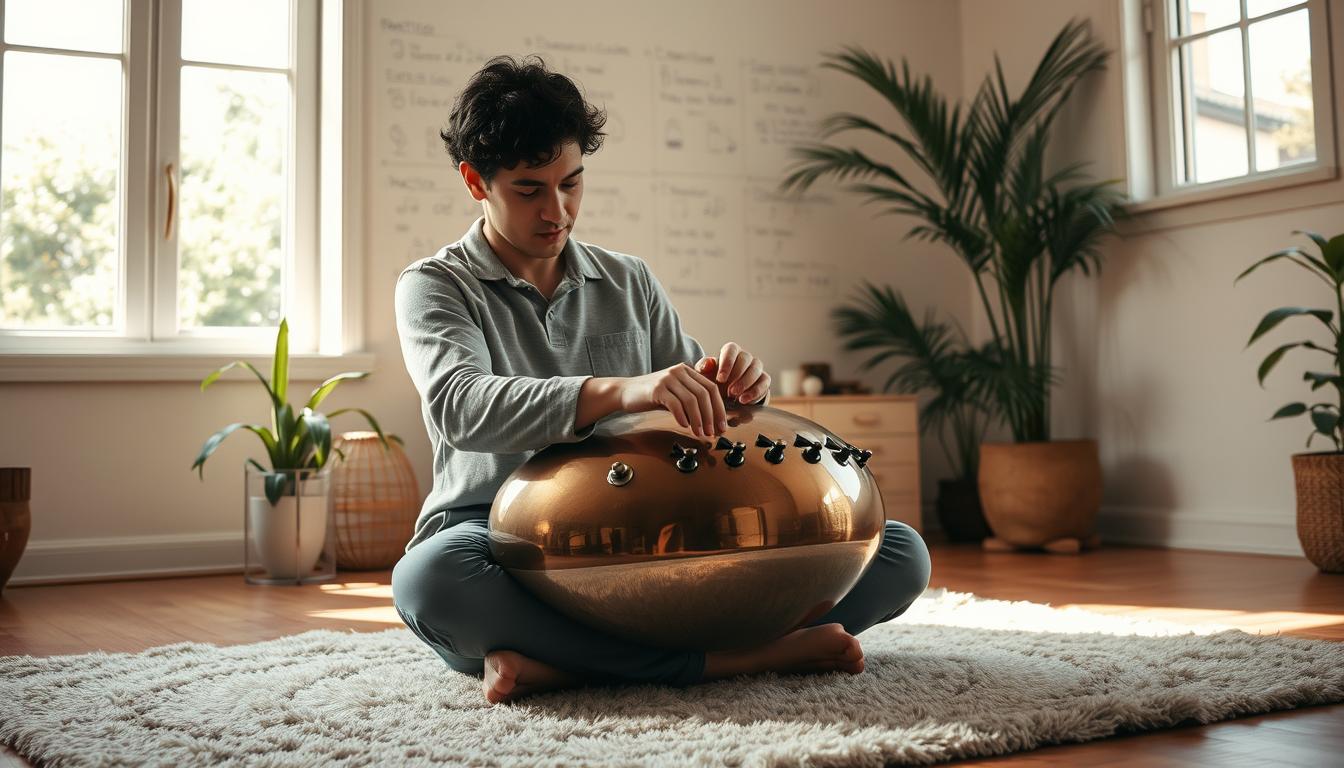

Welcome to this practical guide to making real progress from your first practice sessions.
In a few weeks, you will be able to keep time, play simple patterns and put together a short set.
A realistic promise: make steady progress without skipping steps through short, regular sessions and a method focused on movement and rhythm.
This first-weeks approach aims to build solid foundations: clean sound, accurate hand placement and consistency before speed.
Who this is for: beginners, new handpan owners and musicians who keep playing the same thing and want to structure their learning.
The essentials: a suitable instrument, clean technique, a metronome, core patterns, variations and recordings for self-correction.
To get started, you need a tuned instrument, a quiet place, a metronome app, a phone for recording and 15 to 20 minutes a day.
Getting started with the handpan: choosing an instrument and understanding its notes and resonance
Starting with an instrument that sounds clear and stays in tune builds confidence from the first session. Understanding its structure helps you place your fingers correctly and listen more closely.
Structure and striking areas
The ding is on the upper shell: the central note and the surrounding notes form the melody. The gu, beneath the instrument, contributes to the resonance and depth of the sound.
Striking the centre produces a rounded attack. The edge gives a sharper accent. Hitting harder does not necessarily improve the sound.
Number of notes and choice of scale
For beginners, eight or nine notes reduce mental overload and help you place each strike accurately. The central note guides your ear and anchors the circle of notes.
Choose a scale that feels comfortable under your hands. This method works with any scale.
Quality, price and mistakes to avoid
What to look for: stable tuning, even resonance, no buzzing and a good balance between notes. A poor-quality instrument slows learning.
| Criterion | Why it matters | How to check |
|---|---|---|
| Tuning | Keeps the melody in tune | Listen to clear recordings or try the instrument in a shop |
| Resonance | Lets you control how long a note rings | Test each note and listen to its sustain |
| Finish and warranty | Reduce unwelcome surprises | Choose sellers you can identify who accept returns |
Tip: a good, simple instrument is better than a complex one. It will be easier to control from the first week.
Build the foundations on day one: posture, hands and clean movement
A simple posture and small movements make your early sessions productive. The aim is to produce a consistent sound without tiring yourself out.
Physical setup: sit comfortably with your back straight but relaxed and your shoulders down. Steady the instrument on your lap or a stable stand so it does not move and you can strike accurately.
Comfort rule: if your wrists or shoulders tense up, make your movements smaller. Tension suggests that the movement is too large or forced.
A stable, relaxed position for playing without fatigue
Rest your hands lightly, with your fingers relaxed. Keep movements small and consistent on both sides to produce an even sound.
Flexible fingers, rounded attacks and resonance control
Aim for a rounded strike rather than a sharp blow: brief contact, a natural rebound, then release. Learn to let notes ring or mute them for greater clarity.
Centre, edge and muted notes: varied tones with little force
Centre: full, gentle sound. Edge: a sharper percussive accent. Aim for the same spot each time within a given area.
Muted notes can form rhythmic building blocks: stop the sound cleanly with your palm or a finger without losing musicality. They are an expressive tool, not just a way to correct the sound.
- Consistency: use the same movements, hand height and intention for an even sound.
- Day-one mini-routine: spend two minutes striking two or three notes slowly, alternating between centre and edge, then two minutes practising muted notes.
| Element | Practical advice | Goal |
|---|---|---|
| Posture | Sit steadily with the instrument supported | Avoid fatigue |
| Hand placement | Relaxed fingers and small movements | Even sound |
| Striking areas | Centre: gentle; edge: percussive | Vary the tone |
| Muted notes | Stop the sound cleanly without pressing hard | Create rhythmic accents |
To develop your rhythm further, try these five easy rhythms. They build on these foundations and broaden your handpan practice.
Rhythm first: feeling the beat and practising with a metronome
Feeling the pulse turns a sequence of notes into living music. Start by spending a few minutes on the beat alone: listen to the click, count aloud and let your body follow it.
Count to stay consistent
Count “1-2-3-4,” then add “and” between the beats. Saying the rhythm aloud helps coordinate your hands and eyes. After a few repetitions, stop counting aloud and let your body keep the pulse.
Straight rhythm and swing
First play evenly, with equal subdivisions. Then shift the second subdivision slightly to create a groove. The goal is to change the feel without losing the click.
Practical method
- At 60 to 80 bpm, play one strike per click for 5 to 10 minutes.
- Then play two strikes per click without speeding up, for five minutes.
- Exercise: play a simple pattern straight for four minutes, then with swing for four minutes.
| Goal | Duration | Expected result |
|---|---|---|
| Establish the beat | 5 to 10 min | Steady pulse |
| Even subdivisions | 4 min | Rhythmic accuracy |
| Move into swing | 4 min | An audible groove without losing the click |
Focus on the beat rather than the number of notes: a simple, steady rhythm sounds better than a disorderly stream of notes. For more on the basics, see this practical guide to essential techniques.
Learn the handpan: a practice plan for your first weeks
A simple, consistent routine turns short sessions into visible progress.
Aim for 15 to 20 minutes a day. Regular practice is more effective than occasional long sessions. With this routine, learning becomes sustainable and motivating.
Recommended practice session
A typical structure:
- 5 to 10 min: practise keeping time with a metronome.
- 10 min: carefully repeat one pattern.
- 5 min: explore gentle variations.
- 5 min: practise selected muted notes as accents.
Weekly progression and the golden rule
Week 1: movement and clean sound. Week 2: stability and first variations. Week 3: consolidation and short sequences. Week 4: increase the tempo in steps of 2 to 5 bpm, but only when you can play eight bars cleanly.
Golden rule: start with no more than three or four notes to make your hand placement reliable and avoid rushing around the instrument.
| Goal | Duration | Indicator |
|---|---|---|
| Establish the tempo | 5 to 10 min | Stay with the metronome for eight bars |
| Clean pattern | 10 min | Even sound and consistent movements |
| Variations and muted notes | 5 to 10 min | Consistent accents |
A handy approach: on even-numbered days, practise the pattern alone; on odd-numbered days, add muted notes. If you lose the tempo, slow down and repeat it three times before speeding up.
Essential exercises: five easy patterns to start playing the handpan
These five simple patterns give you a rhythmic toolkit. Each develops a particular skill: swing, compound metre, asymmetry, hand independence or texture.
The rule for each one: listen, count, play slowly with a metronome, add accents, then muted notes, and finally vary the pattern.
- Boom Bap swing: play straight first, then introduce swing and add your first double strikes in sequences of four to eight bars.
- 6/8: feel two groups of three, include rests and accents, and give the phrase room to breathe.
- 7/8 (Kalamatiano): break the rhythm into 1-2 / 1-2 / 1-2-3 and work gradually towards the full cycle.
- Reverse groove: play the dings on beats 3 and 4, add light ghost notes and develop hand independence.
- Gu Groove: alternate strikes on the opening and the metal to create natural bass and snare-like sounds.
| Pattern | Goal | Suggested duration |
|---|---|---|
| Boom Bap | Swing and double strikes | 2 to 4 min per pattern |
| 6/8 | Accents and rests | 2 to 4 min |
| 7/8 | Establish the cycle | 3 to 5 min |
| Reverse groove | Hand independence | 3 to 5 min |
| Gu Groove | Textures from the metal and gu | 2 to 3 min |
Practice format: repeat one pattern for two minutes, add a variation over two bars, then return to the original. To go further, see this exercise guide.
Turn exercises into music: simple melodies, variations and dynamics
A clean pattern becomes musical when you add a small melodic idea and clear dynamics.
Add a melody without losing the tempo
Keep the pattern as your foundation. Choose one or two notes to add to it.
Place them at fixed points, such as the end of a bar. Use the metronome to check that the beat stays steady.
Accents, muted notes and ghost notes for an expressive phrase
Use accents to give the phrase direction. Muted notes create breathing space.
Ghost notes add movement without making the texture too busy. These techniques increase expression without making the part harder to play.
Connect short patterns to build a mini-set
A simple sequence: play three loops of the basic pattern, one loop with a variation, then return to the original. If the return is unsteady, simplify the variation.
Build a two-bar phrase: bar A has a simple pattern; bar B adds a short melodic response. Aim for rounded attacks and play every note with intention.
Rules for beginners: keep a strong reference point, such as the ding or a fixed accent; limit the number of notes; and aim for a consistent sound. This approach makes your playing more musical and helps you learn the handpan.
Track your progress and correct common mistakes
Listening back to your sessions helps you correct small slips before they become habits.
Recording yourself speeds up learning: you can hear slight increases in tempo, unintended accents and the true quality of your strikes.
Record yourself: a three-step listening method
- Listen to 30 seconds, focusing only on the beat.
- Listen to 30 seconds to assess the quality of the sound and your strikes.
- Listen to 30 seconds to assess how consistently your hands move and whether their movements are balanced.
Common problems and their causes
- Muting too late: the movement is too long.
- Random accents: tension and uneven hand heights.
- Losing the tempo: variations are too ambitious.
Immediate fixes and a three-day mini-plan
Slow the metronome considerably, return to the basic pattern, then reintroduce just one variation.
| Day | Goal | Exercise |
|---|---|---|
| Day 1 | Slow tempo | 60 bpm for 10 min, counting aloud |
| Day 2 | Controlled accents | Practise accents and ghost notes for 15 min |
| Day 3 | Clean muted notes | Control each cutoff with consistent movements for 15 min |
Consistent movements: match the path and range of motion of both hands. Watch yourself in a mirror or on a recording to adjust your technique. These mistakes are normal; what matters is knowing what to correct instead of constantly changing patterns.
Resources to help you learn faster: methods, online lessons and community
A guided method reduces guesswork and helps you progress faster.
When should you use outside resources?
If you want structured progression, clear demonstrations and feedback, choose a course. You will spend less time guessing and more time practising.
Immersive overhead videos
Benefit: left- and right-hand movements are easy to follow. Overhead lessons show exact hand placement and reduce confusion.
Intuitive notation and a digital exercise book
A visual system of symbols, colours, numbers and “ghosts” makes patterns readable without music theory. A printable digital book lets you practise offline and maintain your routine while travelling.
Learn at your own pace and join a community
Access across devices and unlimited lesson replays support independent learning. A private community can offer feedback, live workshops and challenges to keep you motivated.
For reassurance: MasterTheHandpan brings together more than 38,000 players and offers coaching and a 14-day guarantee. Compare lifetime access with a subscription based on how often you expect to use it.
For more hands-on guidance, try this focused tutorial.
Conclusion
Use this simple framework to make every session productive.
A suitable instrument, clean movement, metronome practice, five core patterns, then variations and short melodies: that is the path. Favour short, regular sessions of 15 to 20 minutes a day, and play slowly until your sound and hand placement are stable.
Next step: choose one pattern, Boom Bap or 6/8. Practise it with a metronome for seven days. Record a final session and correct one thing at a time.
Remember the golden rule: limit the number of notes until your hand placement is reliable, then gradually expand your playing while keeping the groove steady. If needed, draw on structured lessons, overhead videos, a digital book or a community.
The goal: build a dependable foundation that makes playing enjoyable and regular from today.