
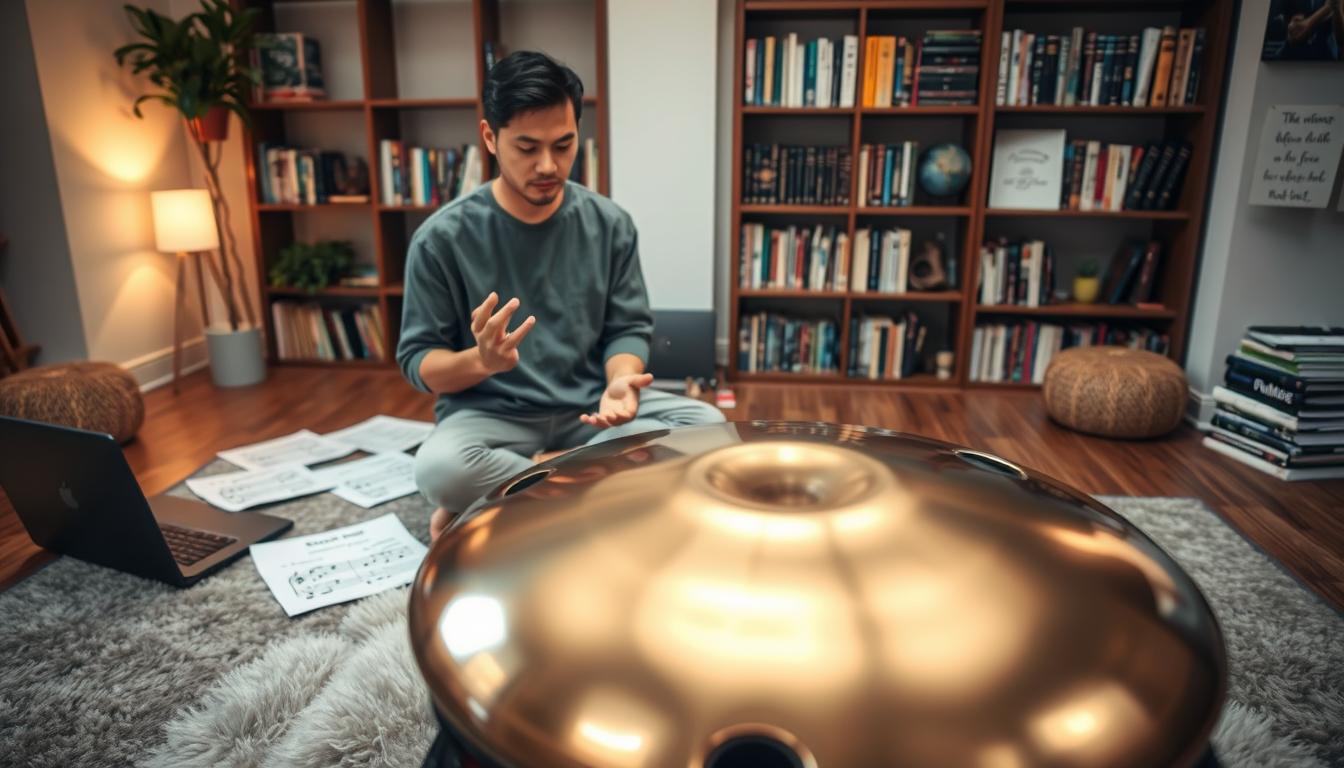

This page helps you determine in practical terms whether an online course can speed up your progress on the handpan.
Many learners plateau when they study alone. They spend time searching through scattered tutorials instead of following a clear learning path.
The method presented here focuses on practical, gradual learning through an easy-to-use platform.
The promise: make faster progress with video lessons, progress tracking and additional resources (notation and an e-book).
We will then examine the criteria for assessing a course: teaching approach, video quality, memory aids, instrument compatibility, flexibility, teacher expertise, prices and student reviews.
You will also discover the “learn by playing” approach, which puts movements, patterns and musicality before theory.
By the end, you will know exactly what you get, how you progress and which plan suits your budget and level as you learn to play the handpan.
Why learning the handpan online can speed up your progress
Following a clear learning path helps you overcome obstacles and turns practice time into real progress. Guided progression reduces uncertainty and unproductive trial and error. You know what to practise, when and how.
The step-by-step method breaks learning into short goals, daily routines and logical stages (rhythm → coordination → musicality). The lessons are practical: you play patterns first, then combine them to improvise.
The videos are designed to be easy to follow. The platform is easier to use than your remote control and requires no prior technical skills. You spend less time navigating and more time playing.
An immersive overhead view means you do not have to mentally reverse every movement when a video is poorly oriented. When the teacher’s left hand does not line up with yours, the mental effort increases and progress slows considerably.
To learn more about this practical approach and why music theory is not required, see how to learn without reading music.
Master the Handpan: Is an online course worth it?
A structured learning path turns irregular practice sessions into visible progress. The modules follow one another, your progress is saved and you pick up exactly where you left off.
Structured videos, patterns broken into steps and focused exercises: everything is designed to develop coordination gradually. You can replay a section as often as you need.
Purposeful repetition: you can repeat a section until the movement becomes automatic. This reduces wasted time and helps you absorb each technique faster.
Guaranteed results and visible progress
The promise of results rests on two things: a clear method and regular practice. The platform supports both with tracking, milestones and a learning history.
“Progress means repeating what matters, not whatever happens at random.”
- Progress indicator and lesson history
- Access on several devices so you can practise wherever you like
- Additional resources (PDFs, notation and an e-book)
| Feature | What it provides | Practical effect |
|---|---|---|
| Video lessons | Patterns broken into steps | Better coordination between your hands and eyes |
| Progress tracking | Automatic resumption at the right point | Time savings and motivation |
| Unlimited repetition | The freedom to repeat the same passage as often as you like | Movements become automatic |
| Resources | PDFs, an e-book and notation | Reinforcement away from the screen |
For a closer look at a platform and its tools, read this detailed review: platform review. It covers the evidence behind the promise and the guarantees offered.
Immersive video lessons so you do not miss a detail
Most conventional tutorials make you mentally reverse every movement. Here, the lessons are filmed from an immersive overhead angle so your hands and the teacher’s hands face the same way.
Immersive overhead view: your left matches the teacher’s left
This perspective avoids the mirror effect. Matching orientations reduce mistakes and make movements easier to copy.
No more mentally reversing everything
You no longer spend energy switching left and right in your head. With less mental effort, you have more time for useful repetition.
Why a poorly oriented image slows learning
When you must mentally reverse every movement, concentration falls and progress stalls.
This mental reversal considerably slows your ability to memorise patterns and increases fatigue.
Every pattern is shown gradually, step by step
Patterns are broken into short sequences, repeated and then linked together. You work on the angle, hand placement, dynamics and small movements.
The result: you understand the movement, repeat it correctly and enjoy practising regularly, which is essential for progress.
Playful, innovative notation to help you memorise movements quickly
A visual code turns each video into an easy-to-follow routine. The system combines colours, numbers and “ghost” markers to show which finger or hand to use.
Colours, numbers and visual cues
Colours show the order of the notes. Numbers indicate the attack or duration. Symbols show when to alternate between your right and left hands. This intuitive notation system helps your hands and brain work together quickly.
Short, effective exercises
Easy-to-remember exercises are designed to take only a few minutes. A few minutes of daily practice can be enough to memorise a pattern and play it again without a screen.
Start without theory
The method lets you start playing without knowing how to read music. Notation guides you at first, then becomes less necessary as the movements become automatic. For more ideas, see these additional resources.
E-book included: keep practising anywhere, even offline
A well-designed e-book lets you keep practising without a screen or internet connection.
Print it and keep practising: the PDF gives structure to your review sessions. It contains exercises, goals and clear reference points. You watch the video, then repeat the movements using the printed document.
Connecting the video to hands-on practice helps you retain the movements between sessions. Your routine becomes focused: short repetitions, tempo control and progress tracking.
Print it and make progress even in remote places without a connection
When travelling or away from Wi-Fi, the printed booklet lets you repeat exercises easily. They fit into breaks and journeys.
PDF resources to reinforce automatic movements between videos
The PDF helps movements become automatic. It offers checklists and sequences to repeat. Note what works and what still needs practice.
Note: most courses include this e-book, but some advanced content may not. To see a complete offer with a booklet included, visit the page about the included booklet.
| Advantage | Use | Effect |
|---|---|---|
| Printable PDF | Offline review | More useful repetitions |
| Structured exercises | Short routines | Movements become automatic sooner |
| Checklist | Simple tracking | Better retention |
Courses fully compatible with your instrument (handpan or tongue drum)
The method rests on a simple, reliable principle. If your instrument has a central note and notes around it, you can follow the courses without complicated adjustments.
A central note with surrounding notes: the key to compatibility
The exercises rely on the relative positions of the sounds. You practise patterns using spatial cues, regardless of the scale’s name. Thus, fully compatible courses means the examples are easy to transpose.
Whatever the scale, tone or number of notes
Even if your instrument’s tone or layout differs, the routines still apply. No particular scale or model is required. The patterns use the relationship between the central note and the other notes.
Also compatible with tongue drums and similar instruments (such as the RAV Vast)
These courses are also compatible with tongue drums and similar instruments such as the RAV Vast. In practical terms, this means:
- patterns you can transpose according to the relative positions of the notes;
- exercises focused on rhythm and coordination;
- adaptation to different numbers of handpan notes.
“A central note and notes around it are enough to play and improve.”
Learn whenever you want, as often as you like
You decide when to practise: the course follows your pace. This freedom lets you turn five spare minutes into a useful session.
Designed to fit your schedule and lifestyle, the format offers short sessions for busy days and longer modules for the weekend. You revisit a lesson, then play, without wasting time.
Access on several devices
Computer for comfort, tablet for portability, phone beside the instrument and Smart TV for a large screen.
Pick up exactly where you left off
Progress tracking saves your place. You resume the video at the right section and repeat the technique until the movement becomes automatic.
“Flexibility and tracking make regular practice easier.”
| Feature | Use | Benefit |
|---|---|---|
| Short sessions | Daily practice | Greater consistency |
| Access on several devices | Practice anywhere | Fewer obstacles to practice |
| Tracking | Resume at the right point | Time savings |
To explore this flexible access and progress tracking, see an example of a course you can use whenever you like in this dedicated resource.
Learning paths for every level: beginner, intermediate and advanced
Each learning path follows a clear sequence, taking you from your first steps to accomplished creative playing. The aim is to provide simple stages with a smooth transition between modules.
Start with “Essentials”: basics, rhythms and first melodies
Essentials teaches the fundamentals: posture, coordination, first grooves and simple melodies. These courses help you enjoy playing quickly and reduce the chance of giving up.
Continue with “Go Further”: advanced techniques and richer playing
Go Further develops rhythmic skills, expression and creativity. It focuses on technical control and the ability to build musical phrases.
Advance through the levels and masterclasses
Levels 1 to 3 structure your progress (86, 83 and 86 lessons). Themed masterclasses cover composition, grooves and compound time signatures.
| Learning path | Audience | Approximate number of lessons |
|---|---|---|
| Essentials (handpan) | Beginner | 79 lessons |
| Essentials (tongue drum) | Beginner | 75 lessons |
| Go Further (intermediate) | Intermediate | 80 lessons |
| Masterclasses (examples) | Advanced | 70 to 122 lessons |
“Following the order foundations → further development → masterclass reduces gaps in your skills and speeds up progress.”
Respected teachers and an extensive masterclass library
Good teachers help turn approximate movements into sound techniques.
The teachers featured here are experienced educators as well as accomplished performers. A good performer is not always a good teacher. These instructors know how to explain each learning stage and make it easy to reproduce.
Internationally recognised contributors: David Kuckhermann, Hang Massive, Malte Marten, Nadishana, Manu Delago and others contribute to the courses.
Evidence of their expertise: David Kuckhermann has been nominated for a Grammy Award, has more than 20 years of experience, has taught over 10,000 students and has more than 10 million YouTube views. These figures illustrate his international reach as a teacher.
Varied topics: advanced grooves, percussive fingerstyle, compound time signatures, applied theory, composition, recording and posture.
The library works like a catalogue: you choose according to your goal, whether it concerns technique, creativity, performance or production. Depending on the offer, you can buy these masterclasses individually or access them with a pass.
“Learning from experts helps you progress faster and avoid common mistakes.”
Prices, plans and access: individual course or unlimited pass
Choosing the right plan for your budget can affect how often and how consistently you practise.
Individual course: a single payment and lifetime access to the module you buy. This suits a specific need: a topic, technique or level. You can return to the same material without paying again, which helps reinforce the basics.
Unlimited pass / Academy: a subscription giving access to all courses and new masterclasses (three to four a year). Example price: €39 per month (sometimes €21 per month during promotions). This plan suits you if you want variety, continuous progress and new material without buying each course separately.
Budget and value for money: depending on how often you use it, the subscription can cost about €1 a day. That is often cheaper than regular private lessons and gives you more flexibility to practise frequently.
What the Academy includes:
- a private community and feedback from other members;
- live or recorded workshops;
- coaching, webinars, challenges and rewards.
| Option | Use | Who it suits |
|---|---|---|
| Individual course | Lifetime access to focused material | A specific short-term goal |
| Unlimited pass | Access to all courses and new material | Long-term progress |
| Discounted subscription | Reduced price (for example, €21 to €39 per month) | A limited budget |
How to choose: pick an individual course if you have a short-term goal. Choose the pass if you want guidance, variety and the support of a community. To explore a specific masterclass, see the composition masterclass.
“Satisfied player” guarantee and student reviews in France
A clear guarantee makes it easier to try a course. You have 14 days to test the method and stop if it does not suit you.
14 days to be satisfied or get a full refund, with no questions asked
No questions asked: you receive a full refund if you are not satisfied within 14 days. This offer reduces the risk of trying the course.
38,000 players trust the method: feedback on teaching and motivation
38,000 players trust the method. Their feedback mentions quick progress, clear lessons and an enjoyable approach. Comments often mention faster improvement, accessible teaching, useful PDFs and a supportive community.
Learning remotely, but never alone: support and mutual help
A private space, workshops, coaching and challenges help you practise regularly. Mutual support reduces isolation and sustains motivation.
“Trying it without risk makes it easier to commit and assess the value of the learning path.”
| Guarantee | What it provides | Effect |
|---|---|---|
| 14 days to be satisfied or receive a full refund | A risk-free trial | Peace of mind when deciding |
| 38,000 players | Student reviews | Greater confidence |
| Community and workshops | Ongoing support | Consistency and motivation |
A practical reminder: if your instrument has a central note and notes around it, the exercises still work, whatever its tone or number of notes. To learn more and read feedback, see this detailed interview: testimonials and interviews.
Conclusion
Ultimately, a clear learning path could save you months of practice.
A good method combines an immersive view, patterns broken into steps, visual notation, a printable e-book and progress tracking. These tools turn your desire to play into measurable progress.
The system fits into everyday life: access on several devices, unlimited lesson viewing and short sessions so you can practise wherever you like.
Are you a beginner? Choose the foundations path. Already comfortable playing? Choose masterclasses to deepen your skills.
Try it without risk: use the 14-day guarantee to test the method, then choose the plan (a focused course or the Academy pass) that matches your goals.