
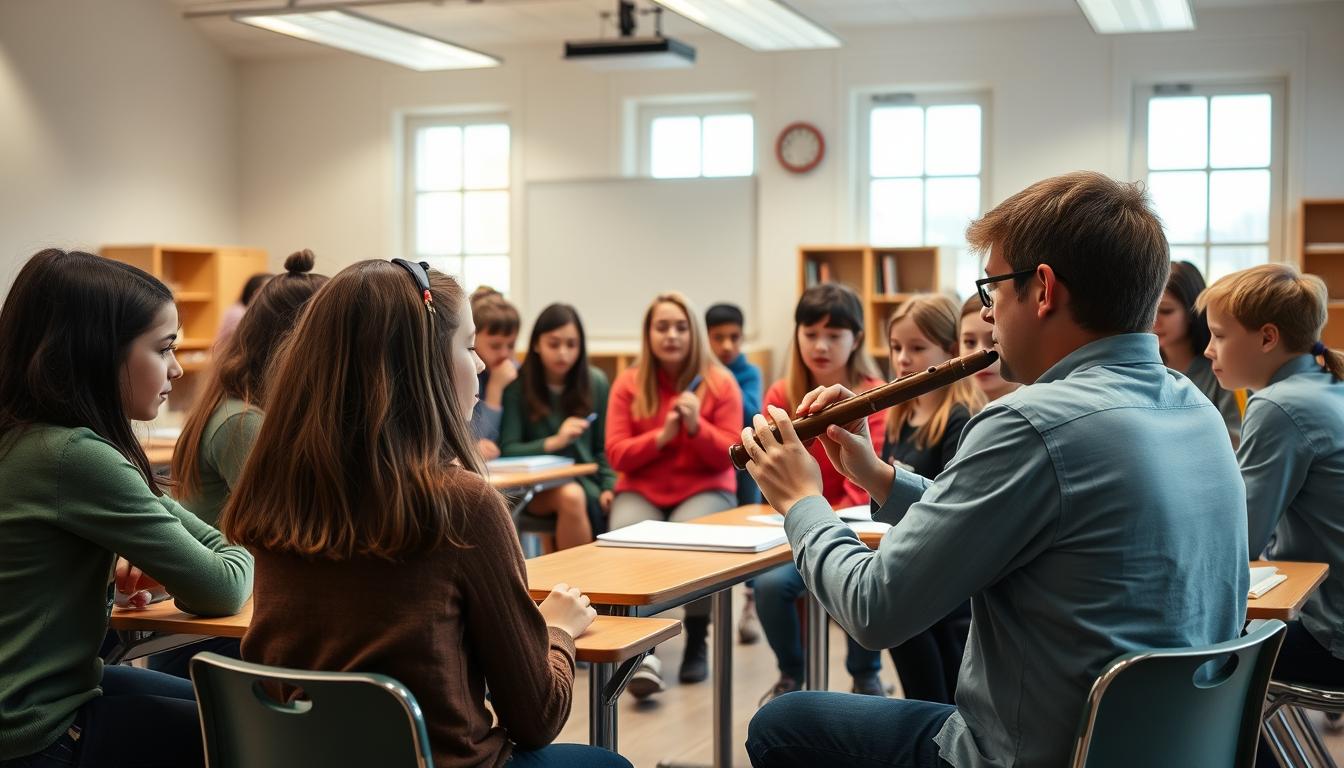

The question of why the recorder is still taught today sparks lively debate. Some argue that this old instrument has unique educational value, while others question its place in modern music curricula.
The recorder has endured since antiquity, while its uses and repertoire have evolved. Discover its rich history and its role in music education. Today, it remains a valuable way to introduce young people to music, especially because it is simple and versatile.
Its teaching is controversial, however. Some teachers, such as Vincent Maestracci, emphasize its importance in developing students’ musical skills. Others, such as Anne-Claire Scebalt, highlight the challenges of learning it. Despite these debates, the recorder remains part of many music curricula.
This article explores the recorder’s past, present and future in music education. We will examine its educational role, cultural benefits and current challenges. Understanding how this instrument bridges tradition and modernity helps explain why it retains a place in school curricula.
Introduction and historical background
The recorder, an instrument with a gentle sound, has endured for centuries while retaining an educational role. Its history reaches back to prehistoric times, when primitive forms were made from bone or wood.
Origins and development of the instrument
Through the Middle Ages, the Renaissance and the Baroque period, the recorder evolved into an essential instrument. Tinctoris’s treatises attest to this development and highlight its role in sacred and secular music.
The recorder in traditional education
From the 16th century onward, the instrument became established in schools because it was accessible. Its moderate cost and simplicity made it ideal for introducing young people to music.
| Period | Characteristics | Impact on education |
|---|---|---|
| Middle Ages | Wooden instrument | Use in sacred music |
| Renaissance | Greater variety of forms | Introduction into schools |
| Baroque period | Musical ornamentation | Expansion of the repertoire |
Today, teachers such as Sarah Lefeuvre carry on this tradition and emphasize the importance of personal expression. Discover how the recorder still inspires students.
The recorder’s cultural and artistic heritage
The recorder holds a central place in music history, particularly in the medieval and Baroque periods. Its influence on the repertoire remains significant: composers such as Bach and Telemann wrote notable works for the instrument.
Its influence on Baroque and medieval repertoires
The recorder’s technical characteristics, including its range and ease of playing, enabled composers to create a rich and varied repertoire. Telemann’s sonatas, for example, showcase the instrument’s expressive nuances.
| Period | Characteristics | Impact on the repertoire |
|---|---|---|
| Middle Ages | Instrument made from bone or wood | Use in sacred music |
| Renaissance | Greater variety of forms | Inclusion in polyphonic ensembles |
| Baroque period | Ornamentation and complexity | Development of concertos and sonatas |
The recorder’s use in ensembles and orchestras of the time also helped make it an essential instrument. Today, the craftsmanship behind it remains a valuable heritage passed down through the centuries.
The recorder in contemporary music education
Changes in teaching methods have helped the recorder retain its place in school curricula despite today’s challenges.
Teaching methods and school curricula
Current educational programmes include the recorder in innovative teaching projects. For example, teachers take interdisciplinary approaches by linking music with subjects such as history or literature.
Schools have adopted interactive methods, including practical workshops and group activities, to make learning more engaging. These methods encourage collaboration and creativity among students.
Adapting to new technologies
Digital technologies have transformed how the recorder is taught. Educational apps and recording software are now used to improve practice.
For example, online platforms allow students to take lessons remotely and share their progress with their teachers. These tools make learning more flexible and accessible.
Teachers emphasize the importance of combining tradition with modern approaches. By incorporating digital tools while preserving the instrument’s fundamentals, recorder teaching remains relevant and appealing to new generations.
Why is the recorder still taught today?
The recorder retains its place in education because of its many advantages. It is an accessible, affordable instrument, ideal for introducing young people to music.
Educational and economic arguments
Economically, the recorder stands out for its moderate cost. This helps all students, whatever their background, gain equal access to learning. Its ease of use also makes it an effective teaching tool that encourages group playing and stimulates creativity.
| Advantages | Economic | Educational |
|---|---|---|
| Accessibility | Low cost | Ease of learning |
| Equality | Affordable for everyone | Group playing |
| Effort | Minimal maintenance | Artistic development |
The recorder supports musical development and artistic expression. It plays a key role in widening access to music and making music education more inclusive.
As a recent article points out, using the recorder in class helps maintain a balance between tradition and modernity, confirming its relevance to contemporary school curricula.
Comparison with other instruments used in learning
Learning the recorder has educational features worth comparing with those of other instruments and musical activities. Wind instruments, percussion and singing are often used in music education.
The role of singing and percussion
Singing and percussion offer benefits that complement those of the recorder. Singing helps students develop a command of rhythm and melody, while percussion strengthens coordination and a sense of tempo. Some teachers favour these activities because they are accessible and have an immediate effect on students’ motivation.
| Instrument or activity | Advantages | Complementary role |
|---|---|---|
| Recorder | Easy to learn, moderate cost | Introduction to wind instruments |
| Singing | Vocal development, artistic expression | Foundation for music theory |
| Percussion | Motor coordination, group work | Learning rhythm |
Teachers point out that a variety of musical activities stimulates students’ creativity and engagement. Discover how these approaches fit into school curricula.
Analysis of teachers’ and students’ experiences
Feedback on recorder teaching reveals a range of views. Some teachers and students highlight its educational benefits, while others criticize its limitations.
Firsthand accounts and case studies
A 2012 study by APEMU found that 70% of students enjoyed using the recorder in class. Teachers such as Anne-Claire Scebalt highlight how easy it is to learn and how accessible it is.
Some students and professionals, however, criticize the limited repertoire and technical demands. Benoît Barrail, an experienced musician, notes that a lack of technical challenges can discourage advanced students.
Case studies, such as one at the EREA school in Flavigny, suggest that students who use the recorder are more fulfilled and independent. These findings have influenced changes in educational programmes, which now include more interaction and collaboration.
Despite these criticisms, the recorder remains a key instrument in music education. It helps young people develop basic musical skills and encourages artistic expression.
Challenges and prospects for teaching the recorder
Recorder teaching faces current challenges but also offers opportunities for innovation. Its limitations include problems with sound and a shortage of suitable teaching resources.
Current limitations and possible developments
- Sound problems: some students find the recorder’s sound too high pitched or difficult to control.
- Shortage of resources: teachers report a lack of varied sheet music and modern teaching materials.
- Changing practices: teachers must adapt to new technologies and changes in musical practice.
New approaches and educational innovations
Despite these challenges, innovations are emerging to modernize recorder learning.
- Integrating technology: educational apps now make it possible to practise online and share progress with teachers.
- Interdisciplinary approaches: teachers link music with subjects such as history or literature to stimulate creativity.
- Collaborative projects: group workshops and school concerts encourage collaboration and student engagement.
As a beginner’s guide points out, adapting to new technologies and innovating in teaching are essential to keeping the recorder relevant in music education.
Conclusion
Despite its long history, the recorder retains a special place in contemporary music education. Its development from antiquity to the Baroque period shaped its distinctive educational role. This simple, accessible instrument helps students develop basic musical skills while encouraging creativity and collaboration.
There are many economic and educational arguments in its favour. The recorder’s moderate cost makes it accessible to everyone. Its inclusion in interdisciplinary projects and the use of modern technologies also strengthen its appeal.
Innovation helps the recorder remain relevant in the face of current challenges. Teachers and students are invited to rediscover this iconic instrument, which represents a balance between tradition and modernity. Even as practices change, the recorder retains an important symbolic and educational place in music education.
FAQ
Why is the recorder still taught today?
What are the main differences between the recorder and other flutes?
How does the recorder fit into school curricula?
What are the benefits of playing the recorder for a child?
Are there recorder lessons for adults?
What is the recorder’s typical repertoire?
How do you choose a good quality recorder?
Is the recorder difficult to learn?
What is the ideal age to start learning the recorder?
Are there ensembles or orchestras that specialize in the recorder?
What are the current challenges in teaching the recorder?
How has technology influenced recorder learning?
What role does the recorder play in an orchestra?
How does the recorder contribute to music education?
What are the most difficult passages to play on the recorder?
What impact does the recorder have on a musician’s development?
What is the connection between the recorder and Baroque music?
How has the recorder adapted to modern times?
What role does the recorder play in a music class?
What advantages does the recorder have over percussion or singing?
How do teachers view the recorder’s usefulness in class?
What do students who have learned the recorder say about it?
What are the recorder’s limitations in a school setting?
How might recorder teaching develop in the future?
Sources
- https://en.wikipedia.org/wiki/Recorder_(musical_instrument)
- https://en.wikipedia.org/wiki/Recorder_(musical_instrument)
- https://en.wikipedia.org/wiki/Recorder_(musical_instrument)
- https://en.wikipedia.org/wiki/Renaissance_music
- https://en.wikipedia.org/wiki/Music_education
- https://en.wikipedia.org/wiki/Recorder_(musical_instrument)
- https://en.wikipedia.org/wiki/Recorder_(musical_instrument)
- https://en.wikipedia.org/wiki/Recorder_(musical_instrument)
- https://en.wikipedia.org/wiki/Recorder_(musical_instrument)
- https://en.wikipedia.org/wiki/Recorder_(musical_instrument)
- https://en.wikipedia.org/wiki/Recorder_(musical_instrument)
- https://en.wikipedia.org/wiki/Recorder_(musical_instrument)
- https://en.wikipedia.org/wiki/Recorder_(musical_instrument)
- https://en.wikipedia.org/wiki/Recorder_(musical_instrument)
- https://en.wikipedia.org/wiki/Music_education
- https://en.wikipedia.org/wiki/Music_education
- https://journals.openedition.org/jrem/444?lang=en
- https://en.wikipedia.org/wiki/Music_education
- https://en.wikipedia.org/wiki/Music_education
- https://en.wikipedia.org/wiki/Recorder_(musical_instrument)
- https://en.wikipedia.org/wiki/Music_education